
Content Syndication and Display Advertising: The Power Couple of Modern B2B Marketing

February 10, 2026

According to customers who have A/B tested, teams that run ads and leads in isolation generate up to 2.5x fewer leads.
No single tactic nor single channel can sustainably carry the weight of the entire B2B buyer journey. Buying decisions involve multiple stakeholders, long research cycles, and fragmented touchpoints across channels. The typical B2B sales cycle includes a chain of decision-makers, and most of their evaluation happens independently through online research, with sales accounting for only a fraction of the buyer’s total time during the journey.
This is why content syndication and display advertising increasingly function as a power couple for modern demand generation. Done right, together they form a coordinated system that builds awareness, reinforces relevance, and sustains engagement over time.
How Content Syndication and Display Advertising Work Together
Before looking at their combined impact, it’s helpful to understand how each tactic supports B2B demand generation on its own.
Content Syndication in B2B Marketing
Content syndication involves distributing your existing content, such as whitepapers, reports, webinars, or articles, across third-party industry websites, publications, and professional platforms.
For B2B teams, this enables reach beyond owned channels and helps place content directly in front of relevant audiences who are already consuming industry information. When executed through a reputable syndication provider, this approach allows marketers to target audiences aligned with their Ideal Customer Profile (ICP) and reach buyers during active research phases.
At the same time, content syndication functions as a structured way to build an opted-in database of contacts from the exact personas and accounts a team wants to engage. Rather than attracting anonymous traffic, marketers capture permission-based data tied to real individuals, real companies, and real buying roles. This creates a qualified audience pool that can be activated across future campaigns.
Syndicated content also plays a direct role in lead generation. By using gated assets and structured lead capture, marketing teams can turn content engagement into identifiable prospects, rather than relying solely on anonymous traffic.
Display Advertising in B2B Marketing
Display advertising includes banner ads, native placements, and video formats distributed across the open web. Its primary role is sustained visibility and reinforcement.
For B2B marketers, display ads help maintain presence across long buying cycles and ensure that brand messaging continues to reach prospects even when they are not actively searching for solutions. Display supports awareness, recall, and message consistency, especially when targeting is applied strategically.
In practice, modern display advertising extends well beyond static banners.
- Video formats, including online video (OLV), allow teams to engage audiences visually across web pages through pre-roll, mid-roll, and post-roll placements.
- Connected TV (CTV/OTT) expands that reach into non-linear television environments, enabling brands to appear across streaming platforms and connected devices in front of large, highly targetable household audiences.
- Audio advertising further extends visibility into moments when buyers are listening to music, news, or podcasts, creating additional touchpoints that reinforce brand presence without relying on screens.
When these formats are managed within a single platform, display advertising also becomes operationally more effective. Consolidating media buys and reporting into one source gives marketing teams clearer visibility into performance, more consistent audience targeting, and better control over frequency and messaging across channels. Instead of fragmented impressions and isolated metrics, teams gain a unified view of how visual and audio exposure supports engagement throughout the buyer journey.
When You Split the Power Couple, Performance Suffers
In fact, performance can suffer significantly; one customer saw an 80% drop in the cost of conversion per Marketing Qualified Account. The reason is that when content syndication and display advertising are used together, they strengthen each other’s effectiveness and create a more cohesive buyer experience. In practice, this combination helps B2B teams solve three of their biggest problems at once: limited visibility, inconsistent engagement, and weak signal quality.

Enhanced Visibility
Content syndication expands reach by placing valuable content within trusted industry environments. Display advertising then reinforces that exposure by maintaining brand presence through visual and repeated messaging.
In real terms, this means marketing teams are no longer relying on a single moment of attention. Buyers encounter your brand across multiple touchpoints, first through educational content, then through consistent reinforcement as they continue browsing, researching, and comparing options.
This is especially important for account-based and deal-driven sales environments, where decisions are rarely made by one person. When multiple stakeholders from the same organization are exposed to the same messaging across different channels, it reduces the risk of your brand being forgotten or displaced by competitors later in the cycle.
For sales teams, this shows up as warmer conversations. Prospects are more likely to recognize the brand, understand the problem space, and enter discussions with baseline familiarity instead of starting from zero context.
Increased Engagement
Once initial interest is generated through syndicated content, display advertising supports ongoing engagement and recall. Repeated exposure builds recognition and helps reinforce the relevance of your message as buyers move between research stages.
From a marketing perspective, this solves one of the most common problems with content: good assets that perform well once, then disappear. Instead of relying on a single interaction, teams can extend the lifespan of high-performing content and use display to keep it active in front of the same audience.
From a sales perspective, this consistency improves lead quality. Prospects who have seen multiple messages, engaged with more than one asset, and returned to the brand through different channels are typically more informed, more confident, and more open to conversation.
This also improves handoff between teams. Instead of marketing delivering leads that sales struggles to contextualize, both teams can align around shared engagement signals, what content was consumed, what messages were seen, and what topics generated interest.
Stronger Signal Quality
Beyond visibility and engagement, the combined use of content syndication and display advertising directly addresses one of the most persistent challenges in B2B marketing: weak signal quality.
Most teams collect large volumes of activity data, yet still struggle to determine which interactions reflect genuine buying intent. Clicks, impressions, and form fills often look positive in isolation, but provide little clarity on readiness to buy or likelihood to convert.
When content syndication and display operate together, signal quality improves because engagement is no longer evaluated as disconnected events. Content syndication establishes intent through depth. Buyers are not just seeing a message, they are actively consuming long-form assets tied to specific topics, challenges, and use cases. This creates meaningful context around what they care about and why they are engaging.
Display advertising then adds continuity and validation. Instead of treating content engagement as a one-time signal, display tracks how prospects respond to repeated exposure across formats and environments. Buyers who return, engage again, or respond to multiple messages demonstrate sustained interest rather than casual curiosity.
This filters out noise. Prospects who interact once and disappear naturally deprioritize themselves, while those who show consistent behavior across both channels surface as higher-confidence opportunities. Marketing gains clearer prioritization, and sales receives leads supported by behavioral context instead of isolated metrics.
Rather than relying on more data, this approach creates better data. Signals become connected, progression becomes observable, and engagement reflects real decision-making behavior instead of fragmented marketing activity.
Use Cases: How B2B Teams Apply Content Syndication and Display Together
- Using content syndication to open-up buyer groups, then using display ads to surround and engage those accounts over time.
- Using display advertising to nurture content syndication leads and reinforce key messages after initial engagement.
- Using syndicated content to qualify interest, then activating display campaigns to accelerate movement toward events, demos, or sales conversations.
- Using display ads to re-engage inactive leads captured through content syndication and bring them back into active consideration.
- Using both channels to maintain consistent visibility across multiple stakeholders within the same target accounts.
The Role of Data-Driven Targeting
The effectiveness of both content syndication and display advertising depends heavily on targeting accuracy.
Without reliable data, display campaigns risk becoming broad and inefficient, while content syndication may generate volume without relevance. In practice, this leads to a familiar problem for both teams: high lead counts but low sales confidence.
Strong campaigns rely on multiple layers of data, including:
- Demographics: job role, seniority, and functional responsibility
- Firmographics: industry, company size, revenue, and growth stage
- Technographics: current technology usage and buying environment
- Intent data: research behavior, content engagement, and site activity
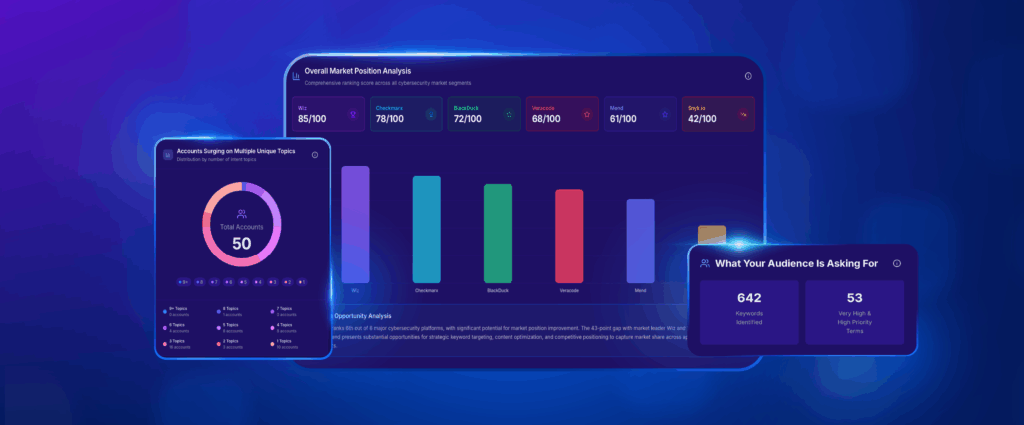
For marketing teams, this allows more precise audience segmentation and more relevant messaging. For sales teams, it means better prioritization, knowing which leads are actively researching, which accounts are warming up, and which prospects are showing buying behavior rather than casual interest.
Targeting also improves internal alignment. Instead of debating lead quality after the fact, both teams can agree upfront on what constitutes meaningful engagement and which signals indicate real buying intent.
Over time, performance data from these campaigns becomes a feedback loop. Marketing learns which content drives the strongest engagement. Sales learns which behaviors correlate with pipeline movement. Together, they refine messaging, improve timing, and allocate budget based on actual outcomes.
How Content Syndication and Display Advertising Help Address the Marketing Data Mirage
Many B2B teams today are facing what is increasingly referred to as the marketing data mirage. Campaign dashboards glow green, engagement metrics appear positive, and lead volume continues to grow. However, despite this apparent performance, sales confidence often declines, and pipeline quality becomes harder to defend.
This disconnect usually exists because most teams are working with fragmented signals. Web traffic, ad clicks, content downloads, and email engagement are measured across different platforms, using different methodologies, and rarely connected to actual buying behavior at the account level. As a result, marketing activity looks productive on paper, while sales struggles to understand which signals reflect real intent.
Combining content syndication and display advertising helps address this problem by reintroducing structure and continuity into how engagement data is generated and interpreted.
When both tactics operate on the same audience data and targeting logic, engagement becomes more than isolated activity. Instead of evaluating performance through individual metrics, teams can observe how buyers move across channels over time, which content introduces a topic, which messages reinforce interest, and which actions indicate progression toward a purchase decision.
In practice, this changes how marketing data is used across teams. Rather than focusing on volume, teams can assess the quality and consistency of engagement. Prospects who interact with multiple assets, return through different channels, and demonstrate topic-specific behavior become more meaningful than those who simply click once.
This improves data confidence in several practical ways:
- Signal quality improves, because engagement comes from defined, qualified audiences rather than anonymous traffic.
- Attribution becomes more actionable, as teams can see how content and ads collectively influence movement through the buying process
- Sales relevance increases, because leads reflect sustained interaction and demonstrated interest
This shared data foundation reduces internal friction. Marketing can justify performance using behavior that aligns with pipeline outcomes, while sales gains clearer context around why prospects are engaging and what shaped their decision process.
Instead of producing more metrics, content syndication and display advertising together produce more reliable signals, signals that reflect real buyer behavior, support better prioritization, and restore confidence in how performance is measured and acted upon.
Stop Running Campaigns. Start Running a System.
Ultimately, the real shift is not about adopting two tactics, but about treating leads and ads as part of the same operating model. Content syndication and display advertising illustrate how this can work in practice, by showing what happens when identity, intent, and visibility are managed together instead of in isolation.
When these functions are aligned, marketing moves beyond generating activity and starts shaping buyer behavior with structure and continuity. This is not the only way to combine leads and ads, but it is a clear example of what becomes possible when engagement is designed as a connected system rather than a series of disconnected programs. Modern B2B teams know both tactics are needed, but few are managing them together. And when marketing’s power couple is kept apart, both performance and pipeline pay the price.
Rethink how your leads and ads could work together as one united system.
Related Blogs

What is Content Syndication? The Key to Generating Leads and Increasing Conversions
Content syndication is the act of republishing your content to other websites, introducing it to new audiences and…
Read More
Mastering Campaign Measurement: A Guide for B2B Marketers
Measurement is crucial for any marketing or advertising campaign to assess whether your investment paid off. Here are…
Read More
The Hidden Perils of B2B Data Deprecation: A Marketer’s Guide
In B2B marketing, accurate data is essential for success. However, data quality can decline over time due to…
Read More
10 B2B Growth-Hacking Tactics for Lead Generation
Growth hacking is one of the most wide-spread “secrets” of small business start-ups. Its meaning can sometimes get…
Read More
An Inquiry vs. a Lead: What’s the Difference?
Many marketers and sales people assume that inquiries and leads are one and the same, but in fact,…
Read More
10 Examples of Awesome Landing Pages that Convert
To lead more users to your products, you need to create a showstopping landing page. To do this,…
Read More
Lead Quantity vs Lead Quality: Achieving a Balance
Traditional sales and marketing strategies have long focused on lead quantity by casting a wide net to capture…
Read More
What Data Solutions Mean for Marketing Technology?
In recent years, marketing has come to rely on the input of big data in order to create…
Read More
PureBits: Lessons on Life & Sales
Selling is tough. There are many buying signals that a salesperson should watch out for to help them…
Read More
How To Create A Super Engaged Audience For Your Brand
The use of hashtags has become so prominent in content, particularly on social media, that it has penetrated…
Read More
Why Quality Leads are Expensive
Getting more leads at a lower cost is always at the top of lead generation objectives, especially for…
Read More