


Your ads are running. Your buyers aren’t seeing them.
That’s not a targeting problem. It’s not a creative problem. It’s not even a budget problem, at least not in the way most marketing leaders think about it. It’s a delivery problem. And it’s costing B2B marketing teams far more than they realize.
The Dashboard Lies
Here’s a scenario that should sound familiar.
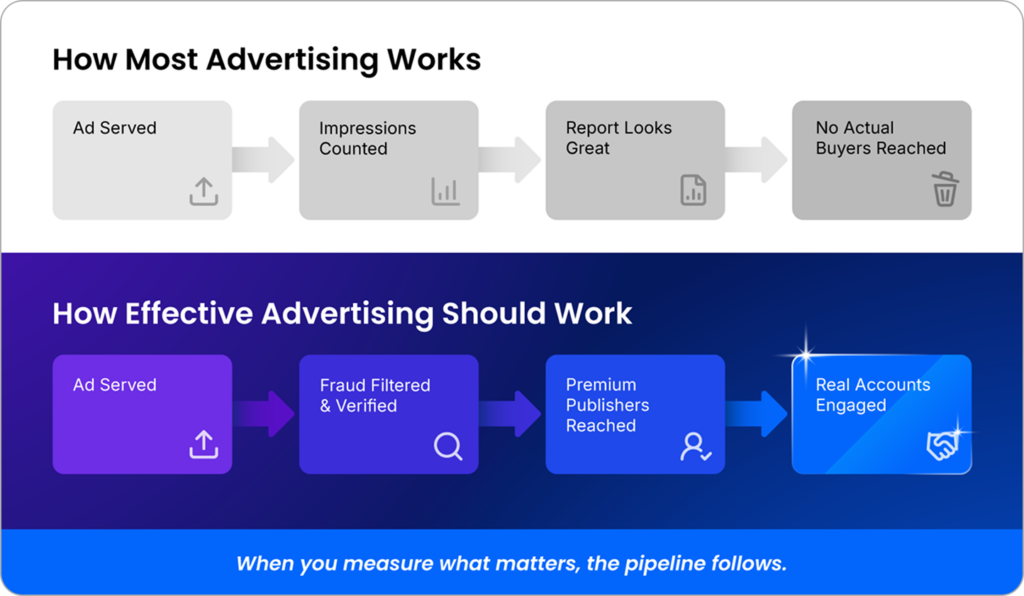
Your programmatic campaign wraps. Impressions delivered. CTR at benchmark. CPM looks efficient. The platform dashboard is green across the board. You report the numbers to your VP, maybe flag some accounts that showed engagement, and move on.
Meanwhile, your sales team is calling into those same accounts cold. No recognition. No brand familiarity. No “oh yeah, I’ve been seeing you guys everywhere.”
The ads ran. The buyers didn’t see them.
This is the defining gap in B2B advertising right now, and it’s hiding in plain sight, buried under dashboards optimized to report activity rather than outcomes.
Where the Budget Actually Goes
Independent research paints a picture most ad vendors would rather you not look at too closely.
- Up to 20–30% of programmatic ad spend is lost to fraud: bots, invalid traffic, and impressions that were technically “served” but never reached a human eye.
- Another 25–50% leaks through media efficiency loss: inflated CPMs, poor inventory placements, over-targeting that saturates the same small audience, and reach that misses the in-market buyers you actually care about.
- Contact data loses accuracy at 25–30% per year as buyers change jobs, titles, and responsibilities.
On a $250,000 annual programmatic budget, it’s entirely plausible that less than half ever reaches a qualified buyer who matches your ICP.
The dashboards don’t show you this. The platforms don’t volunteer it. Most vendors have no incentive to surface it.
The Incentive Problem Nobody Talks About
This is the part worth sitting with.
Your agency is paid a percentage of media spend. They win when you spend more.
Your ABM platform charges an annual license; they win whether the ads work or not. The DSP algorithm optimizes for CTR, because CTR is what it was built to maximize. None of that is the same as your ad budget reaching real, verified buyers at named accounts who match your ICP.
Your agency is paid to buy media. We’re paid for what the media does.
The problem isn’t that these vendors are bad at their jobs. It’s that their jobs aren’t the same as yours. You’re trying to build pipeline. They’re optimizing for the metrics that justify their contracts. That misalignment is structural. And it means the waste isn’t accidental; it’s baked in.
What “Finding Your Buyers” Actually Requires
Reaching the right buyer in B2B advertising isn’t a targeting setting. It’s a system. It requires:
- Fraud filtration that keeps invalid traffic below 3%, not the 20–30% industry average
- Premium, curated inventory on publishers your buyers actually consume, not whatever the open exchange serves up
- Human optimization focused on account coverage and buying committee engagement, not an algorithm chasing clicks
- Contact data that’s continuously refreshed, not a static list decaying at 25% per year
- Transparency to see exactly where your ads ran, which publishers served them, and what percentage of impressions were verified as real
Most programmatic vendors can’t offer all of that. Some can’t offer any of it.
The Question to Ask Your Current Vendor
The fastest way to diagnose whether your ads are finding your buyers is to ask your current vendor for an inventory performance report. A real one, showing every publisher that served your ads, with fraud and brand safety rates attached.
If they hesitate, that’s your answer.
The vendors who can send that report without flinching are the ones whose inventory can withstand scrutiny. Those who can’t or won’t are the ones whose business model depends on you not looking too closely.
There’s a Better Way to Run B2B Advertising
The good news: the waste is recoverable. The buyers are out there.
The gap between where your ads are landing and where your buyers actually are is a solvable problem, if you’re working with a vendor whose incentives are aligned with yours.
That means no platform tax eating your budget before a single impression runs. No black-box optimization chasing vanity metrics. No inventory you’d be embarrassed to show your CEO. And a team of human media specialists who optimize for accounts, not algorithms.
Sources:
- FraudBlocker/Gitnux ad fraud industry data (2023–2024)
- ANA & Measured Programmatic Transparency Report (2023)
- Leadspace/CleanList B2B data decay research (2024)
Full sourcing here.
Want to See Exactly How Much of Your Current Ad Budget Is Reaching Real Buyers, and How Much Isn’t?
Run the DemandScience Advertising Efficiency Calculator to get your personalized estimate in under two minutes.
Related Blogs

What is Content Syndication? The Key to Generating Leads and Increasing Conversions
Content syndication is the act of republishing your content to other websites, introducing it to new audiences and…
Read More
Mastering Campaign Measurement: A Guide for B2B Marketers
Measurement is crucial for any marketing or advertising campaign to assess whether your investment paid off. Here are…
Read More
The Hidden Perils of B2B Data Deprecation: A Marketer’s Guide
In B2B marketing, accurate data is essential for success. However, data quality can decline over time due to…
Read More
10 B2B Growth-Hacking Tactics for Lead Generation
Growth hacking is one of the most wide-spread “secrets” of small business start-ups. Its meaning can sometimes get…
Read More
An Inquiry vs. a Lead: What’s the Difference?
Many marketers and sales people assume that inquiries and leads are one and the same, but in fact,…
Read More
10 Examples of Awesome Landing Pages that Convert
To lead more users to your products, you need to create a showstopping landing page. To do this,…
Read More
Lead Quantity vs Lead Quality: Achieving a Balance
Traditional sales and marketing strategies have long focused on lead quantity by casting a wide net to capture…
Read More
What Data Solutions Mean for Marketing Technology?
In recent years, marketing has come to rely on the input of big data in order to create…
Read More
PureBits: Lessons on Life & Sales
Selling is tough. There are many buying signals that a salesperson should watch out for to help them…
Read More
How To Create A Super Engaged Audience For Your Brand
The use of hashtags has become so prominent in content, particularly on social media, that it has penetrated…
Read More
Why Quality Leads are Expensive
Getting more leads at a lower cost is always at the top of lead generation objectives, especially for…
Read More