

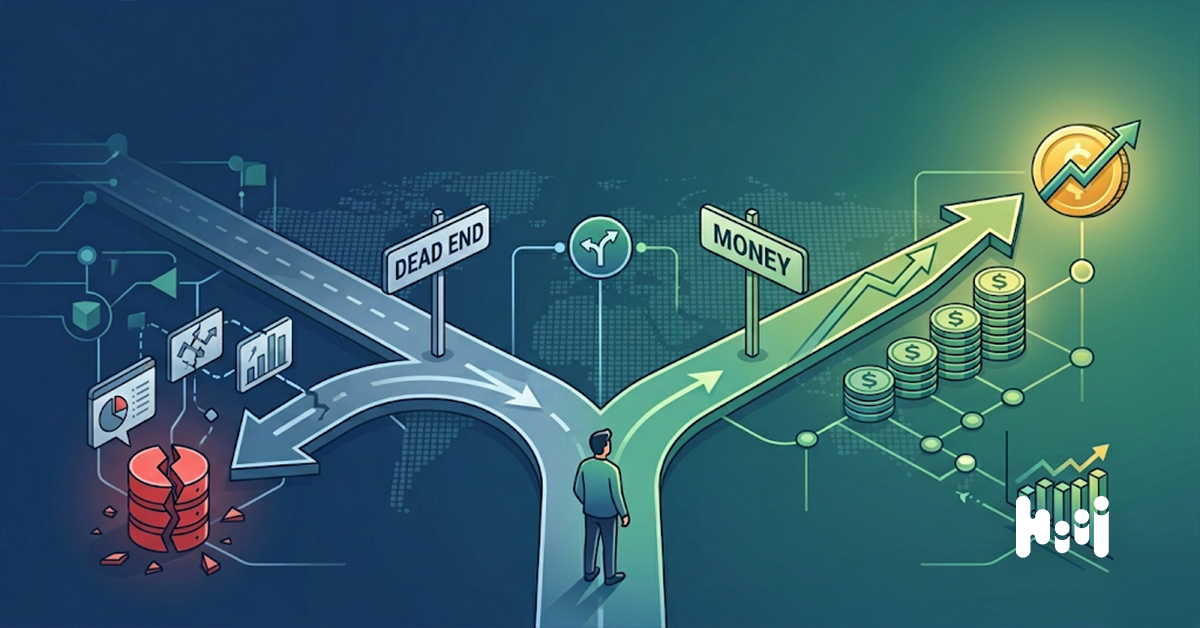
Here is the number that should stop every marketing leader cold: roughly 25% of annual marketing spend is wasted.
Not misallocated. Not suboptimal. Wasted, as in, gone, with nothing to show for it.
Our 2026 State of Performance Marketing research surfaced that estimate directly from marketing leaders themselves. Which makes it harder to dismiss. These are not critics of B2B marketing. These are the people running it.
So here is the question that deserves an honest answer: How did we get here?
Not for lack of technology. Not for lack of data. Over the past fifteen years, the B2B marketing industry built an extraordinary infrastructure for seeing buyers. We know which accounts are researching. We can identify buying groups, track engagement across channels, score intent, model propensity, and monitor website behavior in real time.
We got very, very good at visibility.
What many organizations still struggle with, and what that 25% waste figure quietly indicts, is translating all of that visibility into coordinated action. We solved the seeing problem. We largely left the doing problem alone.
That distinction is not a minor operational gap. It is the structural flaw underneath every missed forecast, every pipeline review that should have gone better, and every quarter-end conversation nobody wanted to have.
Marketers Ended Up Paying the Platform Tax
When organizations encountered this gap, the industry’s response was remarkably consistent: add another platform.
Need better targeting? Platform. Need better intent signals? Platform. Need AI? More platforms. Attribution? You already know the answer.
Over time, that logic compounded into something expensive and exhausting. Not just expensive in licenses — though that too — but in integration work, governance requirements, specialized talent, and the sheer operational drag of making disparate systems talk to each other. We call this the Platform Tax.
The Platform Tax is not a line item. It is a slow accumulation of technical debt, organizational complexity, and opportunity cost. It is the reason smart marketing leaders can look at a stack that costs millions annually and still feel, despite everything, that they should be getting more out of it.
And here is the part that stings: the platforms delivered exactly what they promised. We can see more than ever before. The problem was never the visibility. The problem was what came next.
Read more: Why Your Dashboards Lie
Why Unbundling Alone Won’t Solve It
The market’s response to Platform Tax fatigue is now in full swing. Organizations are reevaluating large suite investments and moving toward more modular approaches — specialized tools, AI-native workflows, custom operating environments built to finally deliver the control the platforms never could.
For some organizations, this is exactly the right move.
For many others, it simply relocates the problem.
Here is what unbundling does not solve: someone still has to determine which accounts matter most. Someone still has to coordinate content, channels, and outreach. Someone still has to govern AI workflows, manage data quality, connect signals to action, and measure what actually moved pipeline. The technology changes. The orchestration challenge does not.
The organizations pulling ahead are not the ones with the most advanced tools or the largest stacks. They are the ones that have learned how to connect intelligence, content, activation, and measurement into a coordinated system, spending less time managing technology and more time converting insight into action.
The Next Era Has a Different Name
The platform era was defined by one word: visibility.
The next era will be defined by orchestration.
Not visibility into more signals. Coordination of the signals you already have. Not more data collection — operationalization of it. Not another AI tool bolted onto a fragmented system, but a connected operating model that reliably translates intelligence into pipeline.
The highest-performing organizations are already moving in this direction. They are connecting buyer intelligence, content, activation, optimization, and revenue measurement into systems designed to produce outcomes, not generate activity. And they are doing it without necessarily having the most sophisticated AI integrations. They are doing it by thinking differently about how all of the pieces fit together.
We believe a new category is beginning to form around this reality. Not another platform. Not another agency. Not another intent vendor.
Something closer to intelligence-driven managed orchestration; an approach that combines intelligence, execution, optimization, and accountability into a unified operating model focused on one thing: pipeline.
The Question That Actually Matters Now
For years, the conversation in B2B marketing has been organized around a single question: What platform should we buy next?
The 2026 marketing leader needs a different question: What operating model will allow us to turn intelligence into pipeline, consistently, repeatedly, without requiring our teams to manage a second job’s worth of system complexity?
The platform era helped us see more than ever before. Those advances are real, and they will continue to compound. But visibility was never the finish line.
Revenue is.
The organizations that close the gap between what their dashboards show and what their pipeline actually delivers will not be the ones who found a better platform. They will be the ones who built a better model.
That is the conversation the industry needs to have next.
Interested in where your current operating model has gaps?
The 2026 State of Performance Marketing report breaks down where B2B marketing budgets are leaking, and what the shift to pipeline-first actually looks like.
Related Blogs

What is Content Syndication? The Key to Generating Leads and Increasing Conversions
Content syndication is the act of republishing your content to other websites, introducing it to new audiences and…
Read More
Mastering Campaign Measurement: A Guide for B2B Marketers
Measurement is crucial for any marketing or advertising campaign to assess whether your investment paid off. Here are…
Read More
The Hidden Perils of B2B Data Deprecation: A Marketer’s Guide
In B2B marketing, accurate data is essential for success. However, data quality can decline over time due to…
Read More
10 B2B Growth-Hacking Tactics for Lead Generation
Growth hacking is one of the most wide-spread “secrets” of small business start-ups. Its meaning can sometimes get…
Read More
An Inquiry vs. a Lead: What’s the Difference?
Many marketers and sales people assume that inquiries and leads are one and the same, but in fact,…
Read More
10 Examples of Awesome Landing Pages that Convert
To lead more users to your products, you need to create a showstopping landing page. To do this,…
Read More
Lead Quantity vs Lead Quality: Achieving a Balance
Traditional sales and marketing strategies have long focused on lead quantity by casting a wide net to capture…
Read More
What Data Solutions Mean for Marketing Technology?
In recent years, marketing has come to rely on the input of big data in order to create…
Read More
PureBits: Lessons on Life & Sales
Selling is tough. There are many buying signals that a salesperson should watch out for to help them…
Read More
How To Create A Super Engaged Audience For Your Brand
The use of hashtags has become so prominent in content, particularly on social media, that it has penetrated…
Read More
Why Quality Leads are Expensive
Getting more leads at a lower cost is always at the top of lead generation objectives, especially for…
Read More