
Self-Serve Advertising Platforms: Pros, Cons, and When to Use DIY vs. Managed
July 16, 2026

The fundamental decision in advertising platform selection isn’t which platform you choose. It’s whether you manage it yourself or outsource to a service provider.
That decision affects everything: your team structure, your timeline, your costs, your control over strategy and execution, and your outcomes. Get it wrong and you’re either building team overhead you don’t need or outsourcing decisions you should control.
Most organizations struggle with this choice because they don’t think about the operational implications. They focus on platform features and miss the structural decision underneath.
This guide explains what self-serve advertising platforms are, shows honest advantages and disadvantages versus managed services, details what resources self-serve actually requires, and helps you make the choice that fits your situation.
For the broader context on comparing B2B advertising platforms, see our evaluation guide. For understanding different platform operational models, explore advertising management platforms. For the strategic foundation, see our B2B advertising platforms guide.
What Self-Serve Advertising Is and Platform Options
Self-serve advertising means you control the platform. You set up campaigns, define audiences, set bid strategy, optimize continuously, and measure results. The platform provides the tools; your team provides the expertise and execution.
What platforms enable self-serve:
- Google Ads (search and display)
- Facebook Ads Manager
- LinkedIn Campaign Manager
- Programmatic DSPs (Demandbase, 6sense, RollWorks self-serve tiers)
- Programmatic display networks
- Individual channel platforms (X Ads, TikTok Ads, etc.)
All of these offer self-serve capabilities. You log in, build campaigns, manage them yourself.
Self-serve vs. platform-managed: Some platforms have both self-serve and managed service options. For example: Demandbase offers self-serve DSP (you manage) and managed programmatic service (they manage). You choose which model fits your situation.
What self-serve requires from you:
- Campaign setup and launch (defining audiences, creating ads, setting targeting)
- Bid strategy management (setting bids, managing budgets, optimizing spend)
- Continuous optimization (monitoring performance, adjusting strategy, testing)
- Reporting and analysis (pulling data, analyzing results, making decisions)
- Troubleshooting (identifying issues, solving problems)
All of this work falls to your team. If you don’t have the team, self-serve becomes burden.
Advantages and Disadvantages of Self-Serve vs. Managed
The fundamental trade-off is control vs. simplicity, complexity vs. speed. Understanding both sides prevents poor decisions.
Self-serve advertising advantages:
- Maximum control: You decide strategy, targeting, messaging, optimization approach
- Cost savings: Platform costs are lower (you’re not paying for service labor)
- Flexibility: You can adjust campaigns quickly, test approaches, pivot strategy
- Learning: Your team builds deep platform expertise
- No vendor dependency: You control execution
Self-serve advertising disadvantages:
- High team overhead: Requires dedicated people (15-20+ hours weekly typical)
- Expertise required: Team needs strong advertising skills, platform expertise
- Slower learning curve: Takes weeks to months to optimize effectively
- Slower time-to-value: Results take longer to show (learning + execution time)
- Single-person risk: If key person leaves, execution suffers
- Requires discipline: Ongoing optimization requires sustained attention
Managed service advantages:
- Low team overhead: Minimal time from your team (3-5 hours weekly typical)
- Expert optimization: Service provider has deep experience
- Fast results: They know what works, implement quickly
- Faster time-to-value: Results visible in 2-4 weeks. Examples like DemandScience accelerate launch through managed execution and audience activation services.
- Reduced single-person risk: Vendor team handles execution
- Scalable: Easy to add new channels or increase budget
Managed service disadvantages:
- Less control: Vendor makes execution decisions, you don’t
- Higher costs: You pay for service labor (not just platform)
- Vendor dependency: Your results depend on vendor quality
- Limited flexibility: Changes require vendor coordination
- Limited visibility: You see results, not all decisions/process
- Switching costs: Difficult to change vendors if not satisfied
Honest trade-off matrix:
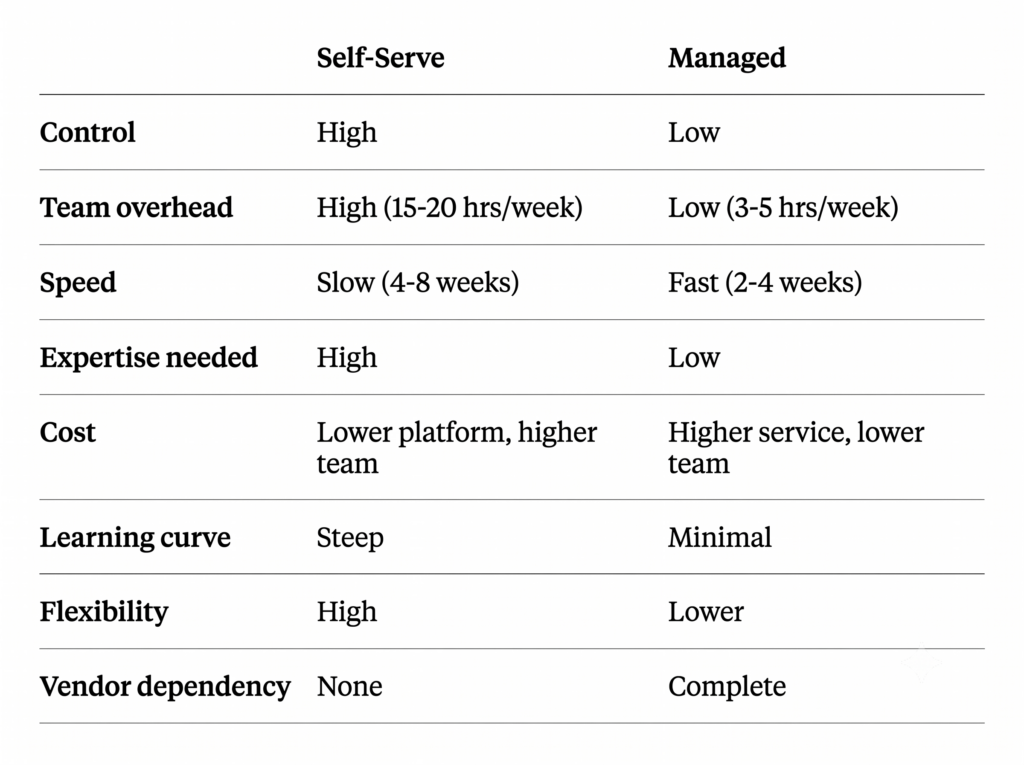
Resources, Skills, and Time Self-Serve Requires
Most organizations underestimate what self-serve actually requires. Being realistic about resource requirements prevents expensive mistakes.
Team structure and skills needed:
If running self-serve campaigns, you need someone with these skills:
- Campaign setup: Understanding audience targeting, platform mechanics, creative requirements
- Analytics: Interpreting data, identifying trends, understanding attribution
- Optimization: Bid strategy, budget allocation, audience refinement, testing
- Copywriting/creative: Ability to create or brief on ad copy and creative
- Strategic thinking: Understanding where advertising fits in broader strategy
You might have one person with all these skills, or multiple people. Minimum is one person dedicating significant time.
Time requirements:
- Setup and launch: 40-60 hours (understanding platform, building campaigns, testing)
- Ongoing optimization: 10-20 hours weekly (monitoring, adjusting, reporting)
- Quarterly planning: 20-30 hours (strategy, roadmap, goal-setting)
- Training and upskilling: 5-10 hours weekly (staying current with platform changes)
Total: One person dedicating 60-80% of their time, or multiple people sharing responsibility.
Cost of self-serve approach:
- Platform costs: $5K-50K+/year depending on scale
- Team time cost: One person at $60K-120K salary = $36K-72K in labor cost
- Training/tools: $2K-5K/year
- Total cost: $43K-127K+ annually
Many organizations don’t account for team cost. They see platform fee ($10K) and think it’s cheap. They miss the $50K+ team cost.
Skill requirements vary by platform:
- Search advertising (Google Ads): Lower complexity, easier to learn
- Programmatic DSPs: Higher complexity, requires deeper expertise
- Multi-channel platforms: Highest complexity, requires broad skills
Deciding Between Self-Serve, Managed Service, and Agency
Making the choice requires honest assessment of your situation.
Choose self-serve if:
- You have (or can hire) strong advertising expertise on your team
- You have sustained bandwidth (60-80% of one person’s time minimum)
- You want maximum control and flexibility
- You have time horizon of 3+ months (time to learn and optimize)
- Your budget is modest (under $50K/year)
- You want to build long-term advertising capability
Choose managed service if:
- Your team lacks advertising expertise (don’t have time to build it)
- You have limited bandwidth (can’t dedicate 60-80% of person’s time)
- You need results quickly (2-4 weeks vs. 8+ weeks)
- Your budget allows for service costs ($50K-200K+/year)
- You prioritize speed and results over control
- You want to outsource operational burden
Choose agency if:
- You need multiple disciplines beyond advertising (creative, strategy, media buying)
- You need hands-on partnership and strategic collaboration
- You want external expertise and fresh perspective
- Your budget is $200K+/year
- You lack internal advertising function entirely
Hybrid approaches:
Some organizations combine approaches.
- Self-serve search (easier to manage) + managed programmatic (more complex)
- Managed service for first 6 months (to learn), then transition to self-serve
- Agency for strategy + in-house for execution
- Self-serve on owned channels (email, site) + managed on third-party channels
Decision framework:
If you answer YES to most of these → Self-serve:
- Do you have team members with advertising expertise?
- Can you dedicate 60-80% of someone’s time?
- Do you have 3+ months timeline?
- Do you prioritize control over speed?
- Is your budget modest ($20K-50K/year)?
If you answer YES to most of these → Managed service:
- Is advertising expertise limited on your team?
- Do you have very limited bandwidth?
- Do you need results in 2-4 weeks?
- Do you prioritize speed over control?
- Can you budget for service costs ($50K-150K+/year)?
If you answer YES to most of these → Agency:
- Do you need multiple services (strategy, creative, media)?
- Do you lack internal advertising function?
- Do you need strategic partnership?
- Is your budget $200K+/year?
- Do you want external perspective?
Final Thoughts: Self-Serve vs. Managed as Organizational Choice
The self-serve vs. managed decision is ultimately an organizational choice. Both approaches work. Choose based on your team, your budget, your timeline, and your goals.
Be honest about resource availability. Don’t assume you’ll find time for self-serve if your team is stretched. Don’t outsource decisions if you want to maintain control. Don’t overestimate team expertise.
Most importantly, accept that this choice may evolve. You might start with managed service to learn, then transition to self-serve. You might start self-serve and move to managed as you scale. Either progression is normal.
Ready to Transform Your Advertising Efficiency?
Discuss your specific situation with a B2B advertising expert and explore how the right operational model improves results.
Related Blogs

What is Content Syndication? The Key to Generating Leads and Increasing Conversions
Content syndication is the act of republishing your content to other websites, introducing it to new audiences and…
Read More
Mastering Campaign Measurement: A Guide for B2B Marketers
Measurement is crucial for any marketing or advertising campaign to assess whether your investment paid off. Here are…
Read More
The Hidden Perils of B2B Data Deprecation: A Marketer’s Guide
In B2B marketing, accurate data is essential for success. However, data quality can decline over time due to…
Read More
10 B2B Growth-Hacking Tactics for Lead Generation
Growth hacking is one of the most wide-spread “secrets” of small business start-ups. Its meaning can sometimes get…
Read More
An Inquiry vs. a Lead: What’s the Difference?
Many marketers and sales people assume that inquiries and leads are one and the same, but in fact,…
Read More
10 Examples of Awesome Landing Pages that Convert
To lead more users to your products, you need to create a showstopping landing page. To do this,…
Read More
Lead Quantity vs Lead Quality: Achieving a Balance
Traditional sales and marketing strategies have long focused on lead quantity by casting a wide net to capture…
Read More
What Data Solutions Mean for Marketing Technology?
In recent years, marketing has come to rely on the input of big data in order to create…
Read More
PureBits: Lessons on Life & Sales
Selling is tough. There are many buying signals that a salesperson should watch out for to help them…
Read More
How To Create A Super Engaged Audience For Your Brand
The use of hashtags has become so prominent in content, particularly on social media, that it has penetrated…
Read More
Why Quality Leads are Expensive
Getting more leads at a lower cost is always at the top of lead generation objectives, especially for…
Read More