
GTM Strategy for 2027: Why Managed Services Are Replacing ABM Platforms

September 4, 2026

You’re in your Q4 budget meeting when the CFO asks the question you’ve been dreading: “We just spent $400K on this ABM platform. Where’s the pipeline?”
Eight months ago you bought the platform to improve pipeline.
You’re still in implementation.
Your AE team is still skeptical.
And you can’t quite explain why the “predictive AI” requires a full-time data scientist to configure.
You are not alone. I spent years at Demandbase helping companies build account-based strategies, and I’m watching something fundamental shift in how smart marketing leaders approach ABM.
They’re moving away from platforms and toward managed services and agencies. And honestly? It’s hard to blame them.
Here’s why this matters for your 2027 GTM strategy.
The ABM Platform Problem (That Nobody Wants to Admit)
Traditional ABM platforms promise transformation and deliver implementation hell.
I’m talking about 6sense, Demandbase, and all the rest. These are sophisticated software products. They do impressive things. And they require your organization to absorb an enormous amount of operational friction to make them work.
You need platforms, tools, people to expertly run them, several marketing teams creating the body of work that powers the ABM strategy, an incredible enablement team to help align with sales, sales buy-in, marketers that push deeper in the funnel than the hand-off, and creative and strategic people to get time and attention from overwhelmed buyers.
The Hidden Tax of Platform ABM:
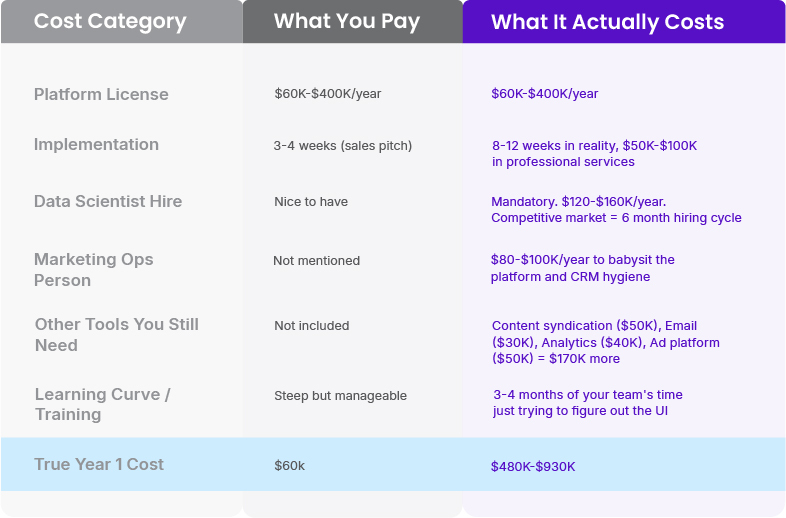
The True Year 1 Cost is the number nobody talks about in procurement meetings.
Then there’s the timeline problem.
You sign the contract in January. You’re “live” in March. But “live” means the platform is installed, not actually running ABM. You spend March through May configuring accounts, scoring models, and testing campaigns. In June, you finally launch your first paid program. And everyone’s on vacation.
By September, you’ve got some data. By November, you might have pipeline movement to show. By December, you’re looking at Q4 performance and realizing you won’t see real ROI until Q3 of the next year.
That’s 11 months from contract to meaningful pipeline. In a world where marketing budgets are flat and expectations are rising, 11 months is career risk.
Here’s what frustrates me most: The platform vendors know this. Complex implementations also create switching costs. Once an organization has invested months in configuration, integrations, training and specialized resources, walking away becomes difficult even when the business case comes under pressure. It creates justification for the price tag. And it creates a built-in excuse if the thing doesn’t work: “Well, you didn’t configure it correctly.”
Why Your CMO Is About to Fire the Platform (And Hire a Service Instead)
Your CFO is in a consolidation mood. She looked at your martech stack last month and realized you’re paying for 23 different tools. Utilization is running at 49%. You’re literally paying for half your stack and getting no value. She’s not angry at you. She’s angry at the entire category.
So when your ABM platform renewal comes up, it’s not just about the platform. It’s about what it represents: complexity, overhead, and unclear ROI.
At the same time, your Demand Gen team is burnt out. They signed up to create demand, not to manage software configuration. Your data scientist (if you managed to hire one) is tweaking scoring models instead of actually running programs. Your sales team is frustrated because they still don’t trust the “predictive” accounts you’re sending them. And you’re hemorrhaging money on implementation costs that don’t move pipeline.
Then you see an alternative: a managed service that handles ABM the way it should work. Not as a software problem. As a demand generation problem.
This is the shift happening now and building more momentum into 2027.
The Managed Service Model: What It Actually Looks Like
Here’s what I mean by “managed service” (and I should be transparent … this is what we do at DemandScience, but the model is bigger than any one vendor).
This isn’t an agency or managed service replacing software. The emerging model combines proprietary buyer intelligence, AI-driven prioritization and orchestration, precision activation, and expert execution in a closed loop. The customer controls strategy, brand, budget and outcomes without having to operate all of the machinery underneath.
Instead of buying software and hiring a team to run it, you hire a team to deliver the accounts, contacts, and ultimately pipeline you need.
What changes:
- You don’t implement. They do. (2 weeks, not 12.)
- You don’t hire a data scientist. They have an entire team.
- You don’t maintain the CRM integration. They do.
- You don’t configure scoring models. They do, and they optimize them weekly based on actual results.
- You don’t figure out media buying, content syndication, audience activation, and attribution. They handle the execution. You handle the strategy.
What you own:
- Confirming account selection and strategy
- Creative and messaging
- Performance review and iteration
- Budget allocation
- Success metrics
What they own:
- Execution across all channels
- Continuous optimization
- Analytics and reporting
- Technical infrastructure
- Team and expertise
It’s the difference between buying a car and hiring a chauffeur (or a self-driving car these days). You still decide where you’re going. You just don’t have to drive.
The Numbers That Make the Case
I pulled together some hard data to show why this model is winning.
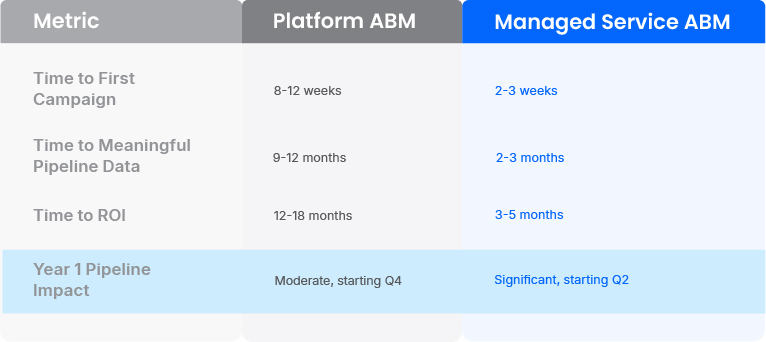
Implementation & Speed to ROI:
Cost Structure:
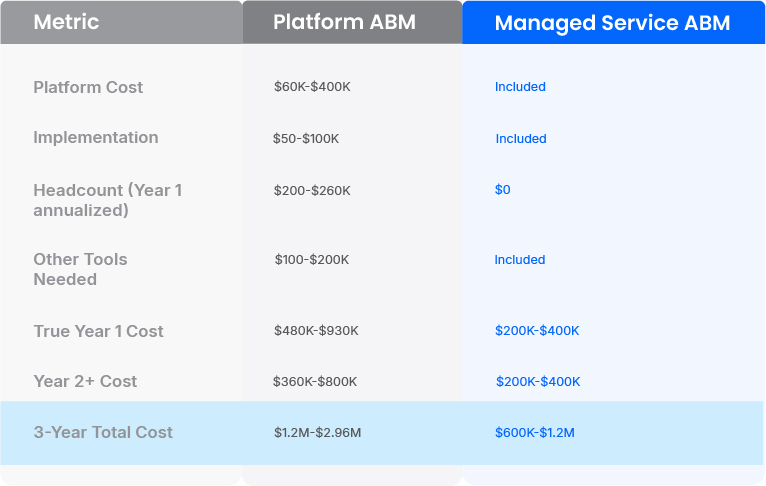
*Cost calculations based on industry benchmarks for platform licensing, typical implementation timelines, headcount requirements, and additional tools. Your actual costs may vary based on organization size and existing martech stack.
Managed services cost roughly one-half of the platform-plus-headcount model over three years.
And you see ROI in half the time.
Lead Velocity:
DemandScience customers running managed ABM see 2-3x more leads in their first 90 days compared to traditional ABM platform implementations. This isn’t because the platforms are bad. It’s because there’s no implementation lag. The machine starts working immediately.
But Will This Work For Your Company?
Managed ABM is a fit if:
✓ You have a $200K+ demand gen budget (smaller budgets favor DIY)
✓ You’re selling B2B SaaS or enterprise software (not B2C, not one-off deal situations)
✓ You’re struggling with headcount constraints (including net new hires and retention)
✓ Your CFO is asking hard questions about martech ROI (consolidation mindset)
✓ You need results faster than 12 months (quarterly budget pressures)
Platform ABM might still be better if:
✗ You have an internal ABM capability already built out and hitting pipeline and revenue targets
✗ You have dedicated resources and love tweaking software
✗ You want full control over every pixel and parameter
✗ Your organization moves slowly and can absorb a 12-month implementation timeline
The Real Conversation Your CFO Wants to Have
Your finance leader doesn’t care about software. She cares about three things:
1. ROI Velocity
“When do we see pipeline, and is it real?”
Managed services answer this: By month 2 and here are the actual opportunities in your pipeline.
Platform ABM answer: Month 12 (or “trust me, it’ll be worth the wait”).
2. Total Cost of Ownership
“What’s this actually going to cost?”
Platform ABM: “Well, the software is $500K, but then you need to add implementation, a data scientist, maybe another ops person, plus content syndication and email, so really it’s like $800K-$1.2M when you add it all up.”
Managed ABM: “$250K-$350K all-in.”
3. Vendor Consolidation
“How many tools is this adding to our stack?”
Platform ABM: 1 (but it requires 4-5 other tools to actually function)
Managed ABM: Consolidates into 1 (unified system replaces content syndication, email campaign management, ad platform, and audience activation)
Frame it this way in your next budget meeting, and watch how fast the conversation changes.
How to Evaluate This (Your Decision Framework)
If you’re considering a move from platform ABM to managed services, here’s the evaluation rubric I’d use:
1. Implementation Speed & Risk
Question: How quickly can we be live and generating pipeline?
What to ask vendors:
- “How many weeks from contract to first campaign launch?”
- “How many weeks from launch to seeing our first leads / engaged accounts?”
- “Can you do this with our existing account list, or do we need to rebuild it?”
Red flag: Anyone saying more than 4 weeks to first campaign.
2. Operating Model
Question: Will this let us reduce headcount, or does it require us to hire more?
What to ask:
- “Do we need to hire a data scientist or ABM specialist to use this?”
- “Do we need additional marketing ops resources?”
- “How much of our team’s time will this require per week?”
Red flag: Adding headcount requirements or “you’ll need a strong ops person.”
3. Outcome Transparency
Question: Will we know if this is working?
What to ask:
- “Walk me through your reporting. How often do we get reports?”
- “Can you show me pipeline influence, not just touches?”
- “How do you handle attribution in a long sales cycle?”
- “What happens if results aren’t meeting targets—how do we troubleshoot?”
Red flag: Black-box algorithms, opaque scoring, “trust the AI.”
4. Consolidation Benefit
Question: Does this reduce our vendor count and tool complexity?
What to ask:
- “Will this replace our current content syndication tool?”
- “Can you handle email campaigns, or do we need a separate tool?”
- “Do you integrate with our existing ad platforms, or are you a separate silo?”
Red flag: Becoming another point tool instead of a consolidation play.
5. Cost Structure Honesty
Question: Is this actually cheaper, or is it creative accounting?
What to ask:
- “What’s the all-in cost for [your specific scope]? No surprises?”
- “What’s included in your managed service? What isn’t?”
- “Are there additional charges for implementation, onboarding, data enrichment?”
- “What’s the pricing in years 2 and 3?”
Red flag: Pricing that’s hard to understand or has lots of add-ons.
A Real Example (Anonymized, But Real)
One of our customers is a mid-market B2B SaaS company ($300M+ revenue). They’d invested significantly in platform ABM. They were deep into implementation, had hired dedicated resources, and had generated qualified opportunities but at a rate trailing their targets. Their CFO was questioning the investment.
They switched to a managed service model.
The results:
- Month 1: Live and running. First campaigns launched.
- Month 3: Qualified opportunities increased 2-3x vs. platform model.
- Month 4: Pipeline significantly exceeded quarterly targets.
- Year 1 Cost: Roughly 40-50% of platform-plus-headcount model.
- Year 1 ROI: Significantly higher than projected from platform model.
They kept the data scientist because she was great. But she went from “keeping the platform alive” to “running strategic ABM initiatives” and “analyzing channel performance.” Completely different value.
The kicker: By month 9, the CEO asked why they didn’t make this move earlier.
The Biggest Objection (And How to Think About It)
“If we go with a managed service, aren’t we giving up control?”
This is the objection I hear most. And it’s worth taking seriously.
Here’s how I think about it:
You never wanted control of the software. You wanted control of outcomes. You wanted to decide which accounts to target, what message to send, what channels to use, and whether it’s working.
A managed service gives you that. What you give up is the ability to tweak the algorithms at 2 AM or optimize a campaign configuration that you don’t actually understand anyway.
The honest trade:
- You lose: hands-on control of the platform, flexibility to build custom workflows, ability to integrate with every random tool
- You gain: speed, simplicity, better outcomes, lower cost, no headcount burden, executive credibility
For most marketing leaders, that’s a trade worth making.
Making the Case to Your Leadership (Your Talking Points)
When you’re ready to pitch this, here’s what to lead with:
To your CFO: “We can consolidate our ABM investment from $700K+ (platform + headcount + tools) down to $300K, eliminate a full-time hire we can’t find anyway, and actually see ROI in 5 months instead of 15. We’d also reduce our overall martech vendor count by 3 tools.”
To your CEO/CRO: “We can be live with ABM in 3 weeks instead of 12, see pipeline impact in Q2 instead of Q4, and hit our pipeline targets for the year. Managed services compress timelines and eliminate implementation risk.”
To your sales leader: “The accounts our ABM program identifies will move faster and closer to your qualification criteria because they’re being continuously optimized based on actual engagement, not static scoring models. Your team will trust the recommendations because you’ll see the data in real-time.”
To your board: “We’re shifting from a platform expense (software + hiring + implementation) to an outcomes-based partnership. We pay for pipeline velocity and efficiency, not for software licenses and configuration complexity. This is how modern demand gen works in 2027.”
The 2027 Inflection Point
Here’s what is happening in the market, and why now matters:
- CMOs are getting fired for missed pipeline targets, not for unconventional tech stack choices.
- CFOs are in consolidation mode, actively cutting vendors and demanding 3-5x ROI on renewals.
- The talent market for ABM specialists is impossibly tight, creating a forcing function toward managed services.
- Martech fatigue is real—49% of organizations have tools they don’t even use.
- Fast-growing companies are bypassing platforms entirely, going straight to managed services because speed is a competitive advantage.
The platform vendors will adapt. They already are. But the fundamental model of sell expensive software, let the customer figure out how to run it is becoming a liability.
The winners won’t be the companies with the most sophisticated GTM software. They’ll be the ones that turn intelligence into pipeline fastest, without paying the operational tax of stitching together and running the machinery themselves.
Your Next Move
If this resonates, here’s what I’d do:
Step 1: Do the math. Pull together your actual Year 1 and 3-year costs for your current ABM approach (or planned approach). Don’t just count the software license. Count implementation, headcount, training, other tools, everything. Be honest.
Step 2: Talk to someone running it. Reach out to peers (or to vendors) running managed ABM services. Ask them about speed to ROI, headcount impact, and costs. Ask for customer references. Actually call those references.
Step 3: Run the scenarios. Model out the 90-day, 12-month, and 36-month outcomes for both approaches. Factor in the pipeline impact, the headcount costs, the tool consolidation, and the CFO approval probability.
Step 4: Make the case. Bring it to your leadership with clear numbers, not hypotheticals. Show the timeline difference, the cost difference, and the risk difference. Be honest about tradeoffs.
The 2027 GTM playbook isn’t “buy the platform and hire a specialist.” It’s “partner with a team that owns your outcomes.”
The data supports it. The market is moving it. Your CFO will appreciate it.
Time to act on it.
What’s your biggest friction point with your current ABM approach? Hit me up. I’m curious what’s blocking you from the velocity you need.
Message Chris Moody on LinkedIn.
Related Blogs

What is Content Syndication? The Key to Generating Leads and Increasing Conversions
Content syndication is the act of republishing your content to other websites, introducing it to new audiences and…
Read More
Mastering Campaign Measurement: A Guide for B2B Marketers
Measurement is crucial for any marketing or advertising campaign to assess whether your investment paid off. Here are…
Read More
The Hidden Perils of B2B Data Deprecation: A Marketer’s Guide
In B2B marketing, accurate data is essential for success. However, data quality can decline over time due to…
Read More
10 B2B Growth-Hacking Tactics for Lead Generation
Growth hacking is one of the most wide-spread “secrets” of small business start-ups. Its meaning can sometimes get…
Read More
An Inquiry vs. a Lead: What’s the Difference?
Many marketers and sales people assume that inquiries and leads are one and the same, but in fact,…
Read More
10 Examples of Awesome Landing Pages that Convert
To lead more users to your products, you need to create a showstopping landing page. To do this,…
Read More
Lead Quantity vs Lead Quality: Achieving a Balance
Traditional sales and marketing strategies have long focused on lead quantity by casting a wide net to capture…
Read More
What Data Solutions Mean for Marketing Technology?
In recent years, marketing has come to rely on the input of big data in order to create…
Read More
PureBits: Lessons on Life & Sales
Selling is tough. There are many buying signals that a salesperson should watch out for to help them…
Read More
How To Create A Super Engaged Audience For Your Brand
The use of hashtags has become so prominent in content, particularly on social media, that it has penetrated…
Read More
Why Quality Leads are Expensive
Getting more leads at a lower cost is always at the top of lead generation objectives, especially for…
Read More