


Demand Generation: Static Model vs. Dynamic Model
Most B2B demand programs today are working. They generate leads. They influence pipeline. They support revenue. Teams are executing well. Channels are optimized. Budgets are allocated thoughtfully.
The question is not whether demand works. The question is how much more it could work.
What if the same budget, the same channels, and the same core tactics could produce materially higher conversion, shorter sales cycles, and stronger win rates?
That is the shift from static demand management to dynamic audience intelligence.
Static programs run against a fixed audience and optimize after the cycle. Dynamic programs continuously refine who deserves investment based on structural and behavioral signals.
The difference is not effort. It is audience precision.
The contrast becomes clear when you look at the math.
In a recent modeled comparison, we looked at two demand programs operating with similar budgets. The first followed the traditional approach: fixed audience, fixed content, even allocation across top, mid, and bottom funnel. After 90 days, that program had closed four deals. The average sales cycle was 127 days. Roughly 22 percent of spend was was allocated to accounts that lacked strong structural conversion signals.
Nothing about the creative was flawed. The team was capable. The tactics were reasonable. By traditional standards, that would be considered solid performance.
The issue was upstream. The audience logic assumed that ICP fit equaled win probability.
That assumption is not always true.
The dynamic model in the same scenario took a different approach. Before activation began, accounts were reprioritized using verified technology install data, spend maturity signals, competitive exposure, replaceability context, and active buyer research behavior. The overall budget did not increase. What changed was the logic behind who deserved investment.
After 90 days, the dynamic program had closed eleven deals. The average sales cycle dropped to 58 days. Wasted spend declined from 22 percent to just 4 percent.
The difference was not tactical optimization. It was structural prioritization.
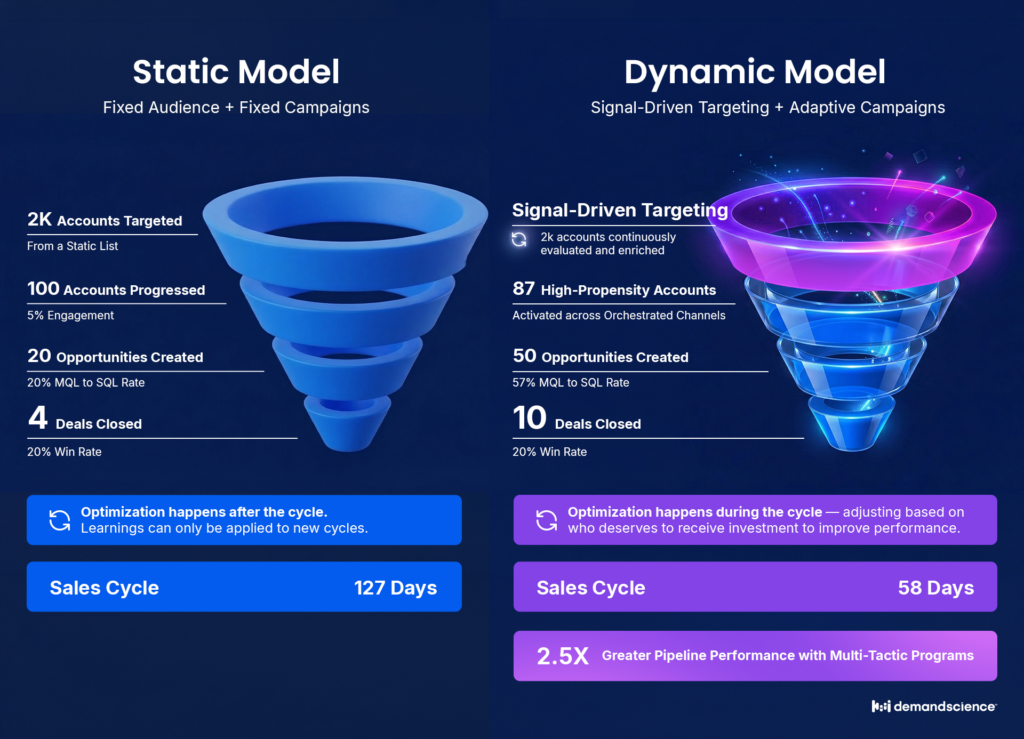
When targeting reflects real conversion likelihood instead of static firmographic similarity, performance compounds quickly. Customers running coordinated, multi-tactic programs instead of isolated single-channel efforts have seen as much as 2.5 times stronger performance. One large cloud vendor reduced the marketing cost to qualify an account by 400 percent after shifting from broad list-based targeting to intelligence-driven prioritization. And according to HG Insights, organizations applying deep install, spend, competitive, and buyer intelligence to account prioritization have realized 10X improvements in conversion and 49 percent revenue lift.
Those numbers are not cosmetic gains. They signal a fundamentally different operating model.
Static demand generation distributes investment broadly and creates a steady stream of opted-in contacts that can feed BDR teams, nurturing programs, and downstream demand efforts. They have a definite place in the marketing mix. But conversion to pipeline can take a while and be tough to model. Dynamic demand generation concentrates investment where structural conversion potential already exists. Two companies may look identical through a firmographic lens, yet one has the right technology footprint, the right budget maturity, the right competitive displacement opportunity, and active buying signals in motion. The other does not. Static targeting treats them the same. Dynamic targeting does not.
This is why so many revenue teams feel busy but uncertain. The problem is rarely effort. It is rarely channel mix. It is rarely even messaging.
More often, it is that audience selection is based on assumption rather than signal.
When targeting reflects reality, pipeline becomes more predictable. When targeting reflects surface-level fit rather than deeper signal, performance can plateau.
Adding dynamic audience intelligence to your marketing mix is not about adding more tactics. It is about improving the intelligence that governs where those tactics are applied.
That shift is structural.
And it changes everything.
Rethink how your leads and ads could work together as a dynamic demand generation model.
Related Blogs

What is Content Syndication? The Key to Generating Leads and Increasing Conversions
Content syndication is the act of republishing your content to other websites, introducing it to new audiences and…
Read More
Mastering Campaign Measurement: A Guide for B2B Marketers
Measurement is crucial for any marketing or advertising campaign to assess whether your investment paid off. Here are…
Read More
The Hidden Perils of B2B Data Deprecation: A Marketer’s Guide
In B2B marketing, accurate data is essential for success. However, data quality can decline over time due to…
Read More
10 B2B Growth-Hacking Tactics for Lead Generation
Growth hacking is one of the most wide-spread “secrets” of small business start-ups. Its meaning can sometimes get…
Read More
An Inquiry vs. a Lead: What’s the Difference?
Many marketers and sales people assume that inquiries and leads are one and the same, but in fact,…
Read More
10 Examples of Awesome Landing Pages that Convert
To lead more users to your products, you need to create a showstopping landing page. To do this,…
Read More
Lead Quantity vs Lead Quality: Achieving a Balance
Traditional sales and marketing strategies have long focused on lead quantity by casting a wide net to capture…
Read More
What Data Solutions Mean for Marketing Technology?
In recent years, marketing has come to rely on the input of big data in order to create…
Read More
PureBits: Lessons on Life & Sales
Selling is tough. There are many buying signals that a salesperson should watch out for to help them…
Read More
How To Create A Super Engaged Audience For Your Brand
The use of hashtags has become so prominent in content, particularly on social media, that it has penetrated…
Read More
Why Quality Leads are Expensive
Getting more leads at a lower cost is always at the top of lead generation objectives, especially for…
Read More