


The problem with pipeline predictability isn’t signal visibility. It’s how we define opportunity.
High signal visibility has not solved the problem of uneven pipeline predictability. Marketing teams today have more behavioral data than ever before. Intent signals, engagement scores, account activity dashboards, and topic-level research monitoring have made it possible to see buyer interest with remarkable precision. In theory, this level of visibility should make pipeline creation easier.
In practice, the opposite often occurs.
Many teams are successfully identifying accounts that appear active, engaged, and interested. Dashboards show rising activity levels. Engagement metrics trend upward. Target account lists expand as new signals appear.
Yet revenue outcomes remain inconsistent. The problem is not signal availability. Marketing organizations today operate in a world of signal abundance.
The problem is how opportunity is defined. Most targeting models optimize for identifying who looks interested rather than determining who can realistically buy. Research behavior becomes a proxy for buying readiness. Activity is treated as evidence of opportunity. Engagement is interpreted as momentum. This approach creates a subtle but significant distortion in pipeline strategy. Interest is mistaken for feasibility.
So, if interest isn’t enough, what’s missing? It’s the visibility into the structural conditions that determine whether an account can actually adopt a solution.
Account prioritization must therefore evolve beyond monitoring interest signals. It must incorporate an understanding of buying feasibility. Marketing teams must move from asking who appears active to asking which accounts are structurally positioned to adopt their solution.
Until that shift occurs, signal visibility will continue to generate activity without reliably producing revenue.
The Intent Illusion: Why “Active” Does Not Mean “Winnable”
Intent data reshaped modern B2B demand generation by making buyer research behavior visible. Instead of relying only on firmographic filters and static segmentation models, marketing teams could now observe how organizations explore technologies in real-time through content consumption, keyword searches, and topic engagement.
This capability created a clear advantage. Teams could identify accounts earlier in the buying journey and engage before competitors recognized emerging demand.
However, the rise of B2B intent data also introduced a misconception. Many organizations began treating research activity as a reliable indicator of purchase readiness.
Intent platforms surface behavioral signals that indicate interest and investigation. What they cannot reveal is the structural context that determines whether a purchase is actually possible. Intent signals do not show the existing technology environment inside the account, vendor contracts, integration dependencies, or modernization timelines.
As a result, intent often detects attention without detecting feasibility.
An account may generate strong research activity while remaining locked into a multi-year vendor agreement. Another may be exploring alternatives years before budget approval becomes realistic. Others may simply be monitoring the market without any immediate intention to buy.
Where Intent Breaks Down in Complex Technology Sales
In enterprise technology markets, research activity rarely represents a direct path to purchasing. Large organizations investigate solutions continuously, often well before a genuine buying window emerges.
Several common scenarios illustrate why intent signals alone can mislead account prioritization decisions.
The Locked-In Stack
Organizations frequently research alternative solutions while remaining contractually or technically committed to an incumbent vendor. Enterprise technology environments are deeply integrated into operational processes, data infrastructure, and internal workflows. Migration costs can be substantial, and multi-year contracts often prevent replacement.
The Researching Engineer
Technical stakeholders often explore emerging technologies independently of procurement cycles. Architects, developers, and engineers regularly evaluate tools as part of professional curiosity or future planning. Their research activity can trigger intent signals even though budget owners and executive stakeholders have not yet entered an evaluation process.
The account appears active from a signal perspective, yet no formal buying initiative exists.
Innovation Scanning
Many organizations maintain ongoing visibility in new technologies simply to stay informed about the competitive landscape. Market monitoring helps technical teams understand emerging capabilities and industry trends.
This research activity produces detectable signals, but it does not necessarily represent a purchasing initiative.
In each of these cases, the signals themselves are genuine. The account is clearly paying attention. What the signals do not reveal is whether the account can realistically move toward adoption. Intent reveals attention. It does not reveal timing, feasibility, or structural readiness.
The Missing Layer: Buying Feasibility Through Install Intelligence
To determine which accounts can realistically convert, marketing teams must understand the structural conditions shaping technology adoption inside each organization.
This is where install intelligence becomes essential.
Install intelligence is not simply another data layer added on top of intent signals. It functions as the lens that explains why many signals fail to translate into revenue outcomes. By examining an organization’s existing technology environment, install intelligence reveals the infrastructure realities that determine whether change is feasible.
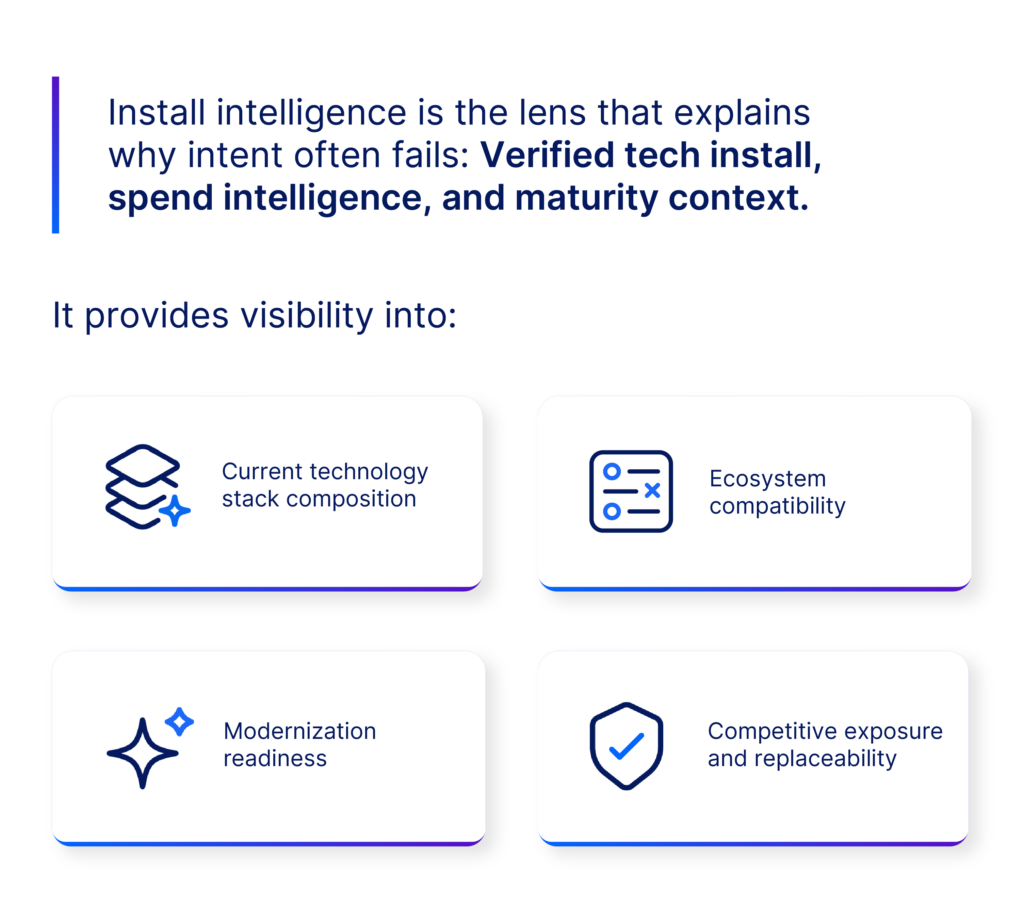
This includes visibility into current technology stack composition, ecosystem compatibility, modernization readiness, and competitive exposure. It also includes understanding which systems are deeply embedded and which are nearing replacement cycles.
In enterprise environments, technology investments create operational inertia. Systems become tightly integrated with business processes, internal tools, and data architectures. Replacing these systems requires careful planning, significant resources, and executive alignment.
As a result, technology adoption rarely happens spontaneously. It follows predictable patterns shaped by infrastructure maturity, vendor relationships, and modernization initiatives.
Install intelligence exposes these conditions.
It enables marketing teams to understand which accounts are capable of adopting new solutions and which accounts remain structurally constrained by their existing technology environment.
Understanding replaceability becomes critical. If a competitor’s platform is deeply embedded and contractually secured for several years, the account may generate research signals but still remain unwinnable in the near term.
Conversely, accounts operating within compatible ecosystems or approaching modernization cycles may present genuine opportunity even before strong intent signals appear.
Install intelligence allows marketing teams to distinguish between accounts that are merely active and those that are truly viable opportunities.
From Interested Accounts to Winnable Accounts
Recognizing the limitations of interest-based targeting leads to a more advanced prioritization concept known as winnability.
Traditional targeting models often rely on two primary indicators. The first is ideal customer profile alignment, which assesses whether an account matches firmographic characteristics such as industry, company size, or revenue. The second is research intensity, which measures behavioral signals suggesting active interest.
While these indicators provide useful insights, they primarily describe who appears relevant and who appears curious.
They do not determine whether a deal is realistically achievable.
A winnable account is defined by structural purchase probability.
Instead of focusing exclusively on fit and research activity, winnability incorporates factors such as infrastructure feasibility, replacement windows, and competitive displacement opportunity.
Accounts become more attractive when their architecture is compatible with the solution being offered. They become even more compelling when evidence suggests dissatisfaction with incumbent vendors or when modernization initiatives create natural replacement cycles.
Current targeting logic:
- ICP fit
- research intensity
Winnable account logic:
- infrastructure feasibility
- replacement windows
- competitive displacement opportunity
When these structural indicators combine with research activity and buying committee engagement, the probability of conversion increases significantly.
This shift reframes demand generation strategy. Marketing teams move away from optimizing audience reach and toward identifying realistic opportunities. It’s not about engaging as many accounts as possible but identifying accounts that can actually move through a buying process.
The High Cost of Wishful Targeting
When marketing teams mistake interest for opportunity, the consequences extend far beyond inefficient campaigns.
Many organizations attempt to compensate by relying on common fixes such as manually maintained ICP lists or large-scale content syndication programs. These approaches can expand reach and surface additional leads, but they rarely solve the underlying prioritization problem.
Manual ICP definitions often remain static for long periods of time and rely heavily on subjective assumptions about market fit. Broad demand generation programs frequently distribute content without distinguishing between accounts that are structurally capable of adopting the solution and those that are not.
This produces outdated intelligence and misallocated resources.
At the executive level, the consequences become visible quickly.
- Inflated Pipeline: Pipeline forecasts become inflated as marketing dashboards report activity that cannot realistically convert into revenue.
- Sales-Marketing Friction: Sales teams begin losing confidence in marketing-generated opportunities after repeatedly encountering accounts that show strong intent signals but lack the conditions necessary to purchase.
- Burned Capital: Wasted media spend and SDR cycles on accounts that were never realistically winnable.
Media budgets fund campaigns targeting structurally constrained organizations. Sales development representatives invest hours pursuing conversations that cannot progress. Marketing teams report increasing engagement metrics while revenue outcomes remain inconsistent.
Forecast accuracy erodes when pipeline is built on activity rather than feasibility. Over time, this disconnect creates tension between marketing and sales and undermines confidence in the demand generation system itself.
From Signals to Strategy: A Smarter Prioritization Model
Improving pipeline predictability requires a more sophisticated approach to account prioritization. Instead of relying on isolated signals, marketing organizations must integrate multiple intelligence layers into a unified decision framework.
A progressive model may include:
| Layer | What It Reveals | Conversion Rate |
| Layer 1: Firmographic Fit | Strategic market relevance. The account matches your target industry, size, and operational profile. | 2% baseline |
| Layer 2: Technographic Install Context | Infrastructure readiness, replacement feasibility, and ecosystem compatibility. The account can structurally adopt your solution. | 15% (7.5x lift) |
| Layer 3: Contextual Intent Signals | Active research behavior and competitive exploration. The account is investigating solutions in your category. | 20% (10x lift) |
| Layer 4: Buying Committee Activation | Organizational alignment. Budget owners, technical evaluators, and executive stakeholders are beginning to converge on an evaluation. | 25% (12.5x lift) |
In practice, this model enables marketing teams to:
- Tier accounts based on realistic opportunity probability
- Sequence campaigns around modernization windows and budget cycles
- Coordinate sales engagement with structurally advantaged accounts
- Optimize channel orchestration toward accounts most likely to convert
As these layers accumulate, conversion probability compounds, transforming account prioritization from a tactical filtering exercise into a strategic capability that determines which opportunities actually convert.
The Future of Demand Generation: From Visibility to Predictability
The next evolution of demand generation will not be defined by the quantity of signals available to marketing teams.
Signals are already abundant.
The defining capability will be the ability to interpret those signals within the broader context of buying feasibility. Forward-thinking marketing organizations are already shifting their strategies. Instead of focusing exclusively on detecting demand, they are developing models that identify when demand can realistically convert into opportunity.
This shift transforms how marketing teams approach targeting.
Detecting demand becomes modeling feasibility. Generating engagement becomes activating propensity. Scaling outreach becomes orchestrating opportunity timing.
Organizations that successfully integrate install intelligence, behavioral signals, and buying committee dynamics will move closer to building predictable pipeline systems. The most valuable accounts aren’t the ones making the most noise; they are the ones positioned to act.
Stop chasing the mirage and start building a predictable pipeline system.
Related Blogs

What is Content Syndication? The Key to Generating Leads and Increasing Conversions
Content syndication is the act of republishing your content to other websites, introducing it to new audiences and…
Read More
Mastering Campaign Measurement: A Guide for B2B Marketers
Measurement is crucial for any marketing or advertising campaign to assess whether your investment paid off. Here are…
Read More
The Hidden Perils of B2B Data Deprecation: A Marketer’s Guide
In B2B marketing, accurate data is essential for success. However, data quality can decline over time due to…
Read More
10 B2B Growth-Hacking Tactics for Lead Generation
Growth hacking is one of the most wide-spread “secrets” of small business start-ups. Its meaning can sometimes get…
Read More
An Inquiry vs. a Lead: What’s the Difference?
Many marketers and sales people assume that inquiries and leads are one and the same, but in fact,…
Read More
10 Examples of Awesome Landing Pages that Convert
To lead more users to your products, you need to create a showstopping landing page. To do this,…
Read More
Lead Quantity vs Lead Quality: Achieving a Balance
Traditional sales and marketing strategies have long focused on lead quantity by casting a wide net to capture…
Read More
What Data Solutions Mean for Marketing Technology?
In recent years, marketing has come to rely on the input of big data in order to create…
Read More
PureBits: Lessons on Life & Sales
Selling is tough. There are many buying signals that a salesperson should watch out for to help them…
Read More
How To Create A Super Engaged Audience For Your Brand
The use of hashtags has become so prominent in content, particularly on social media, that it has penetrated…
Read More
Why Quality Leads are Expensive
Getting more leads at a lower cost is always at the top of lead generation objectives, especially for…
Read More