


It’s 2023. McLaren arrives at the season opener for Formula 1 knowing their car isn’t good enough. Not because the drivers lack talent. Not because the engineers aren’t working hard. Not because they don’t have data or simulation technology. They do. They have all of that. The car still isn’t delivering results.
If you’re a marketer, this story is yours.
Most B2B marketing organizations are McLaren at that moment. You’ve got talented people. You’ve got sophisticated platforms. You’ve got abundant signals and no shortage of activity. Your brand team is building awareness. Your demand team is generating engagement. Your sales team is following opportunities. Everyone is working. Yet the business can still be losing the race.
Here’s what McLaren’s new team principal, Andrea Stella, figured out: the problem wasn’t a lack of engineering. It wasn’t missing one magical component. It was system-level performance.
When you add downforce to a racing car, you create drag. Change the suspension, and you affect tire performance. Every component can perform exactly as designed while the car as a whole still loses. The question shifted from “Who failed?” to “What is preventing the whole system from working?”
That question is exactly what B2B marketing needs to ask itself right now. Kelvin Gee, Principal Analyst at Forrester was my featured guest for a webinar on this topic and shared this McLaren story to get us started.
Watch the on-demand recording of The Great Pipeline Reset.
Your Buyers Decided Before You Started Racing
The buyer landscape has shifted. And if you’re still marketing like it’s 2019, you’re racing with a car that can’t win.
Start with this: 68% of B2B buyers enter a purchase process with a front-runner already in pole position. Not just leaning toward one vendor. Firmly planted. And here’s the kicker: that preferred vendor wins 80% of the time, according to Forrester’s Buyers’ Journey Survey, 2025.
Do the math. The preferred vendor wins 55% of the time on average before anything happens. More than half the time, the race is already won. Or lost.
Meanwhile, the buying group has grown. It’s not four people making a decision anymore. It’s 22 people on average. Thirteen internal stakeholders and nine external influencers. Analysts. Consultants. Peers. Agencies.
And here’s where it gets bad: your sales team reaches 2, maybe 3 of those people. Everyone else in the buying group has made up their mind without you.
How do those people form their opinions? 94% of them use generative AI during their purchase process (G2). They arrive informed. They’re not shopping. They’re confirming. The buyer’s journey has become a process of confirmation, not selection.
All that work. All that effort. All that cost. Often wasted because you’re chasing deals you’ve already lost.
The Platform Tax Is Quietly Eating Your Budget
Here’s an uncomfortable number: 25% of your marketing budget is wasted, according to DemandScience’s The State of Performance Marketing 2026 report.
Not lost to bad strategy. Not lost to underperforming creatives. Lost to overlapping, disconnected tools that don’t talk to each other.
Let’s break down where it’s leaking:
35% of your licensed features go unused. You’re paying for capability you never capture. That’s the license tax.
94% of teams with 16 or more tools spend most of their time fixing problems instead of building programs. They’re firefighting the stack, not running campaigns. That’s the integration tax.
87% of marketing teams chase intent signals they don’t trust. Only 26% convert to qualified opportunities. The volume is huge. The quality is thin. There’s a 60-point gap between signal volume and signal quality. You’re drowning in noise and calling it signal. That’s the signal mirage.
Add it up. 25% of your budget gone to a system that’s broken at the seams.
The platforms themselves aren’t the villain. The problem is that you’ve built a martech stack the way you’ve been building marketing campaigns: in isolation. Brand has its tools. Demand has its tools. Sales has its tools. They don’t connect. They don’t align. They’re running two different cars in the same race.
Marketing Is a House Divided and It’s Costing You
Brand and demand have become separate tribes.
Some brand teams live in an ivory tower. They run “air-cover” campaigns with no direct connection to business outcomes. Want to know the worst part? Only 25% of B2B marketing leaders believe they can measure the ROI of brand investments (Forrester). One quarter. So brand programs get cut when times are tough, exactly when preference-building matters most. It’s like turning off your engine when you need to accelerate.
Demand teams have swung the other direction. They’ve pivoted hard toward intent-based performance marketing and account-based marketing (ABM). They ignore the impact of brand building. They chase this quarter’s deals. Any conversation about long-term preference gets stifled. So they’re increasingly inefficient and ineffective. The market is saturated with intent. Everyone’s buying the same signals. Everyone’s going to the same accounts. Nothing stands out.
Here’s what actually happens: A platform flags a priority account. Your demand team mobilizes. Sales can legally email 2 or 3 opted-in contacts. Everyone crosses their fingers. It fails. The campaign is written off. Everyone blames the messaging. No one audits whether the messaging even reached the whole buying group. The teams build the next campaign. The core issue persists.
That’s not a marketing problem. That’s a system problem.
Get Into Pole Position With Preference Marketing
The fix is preference marketing. And it’s the only way to align brand and demand around one shared outcome.
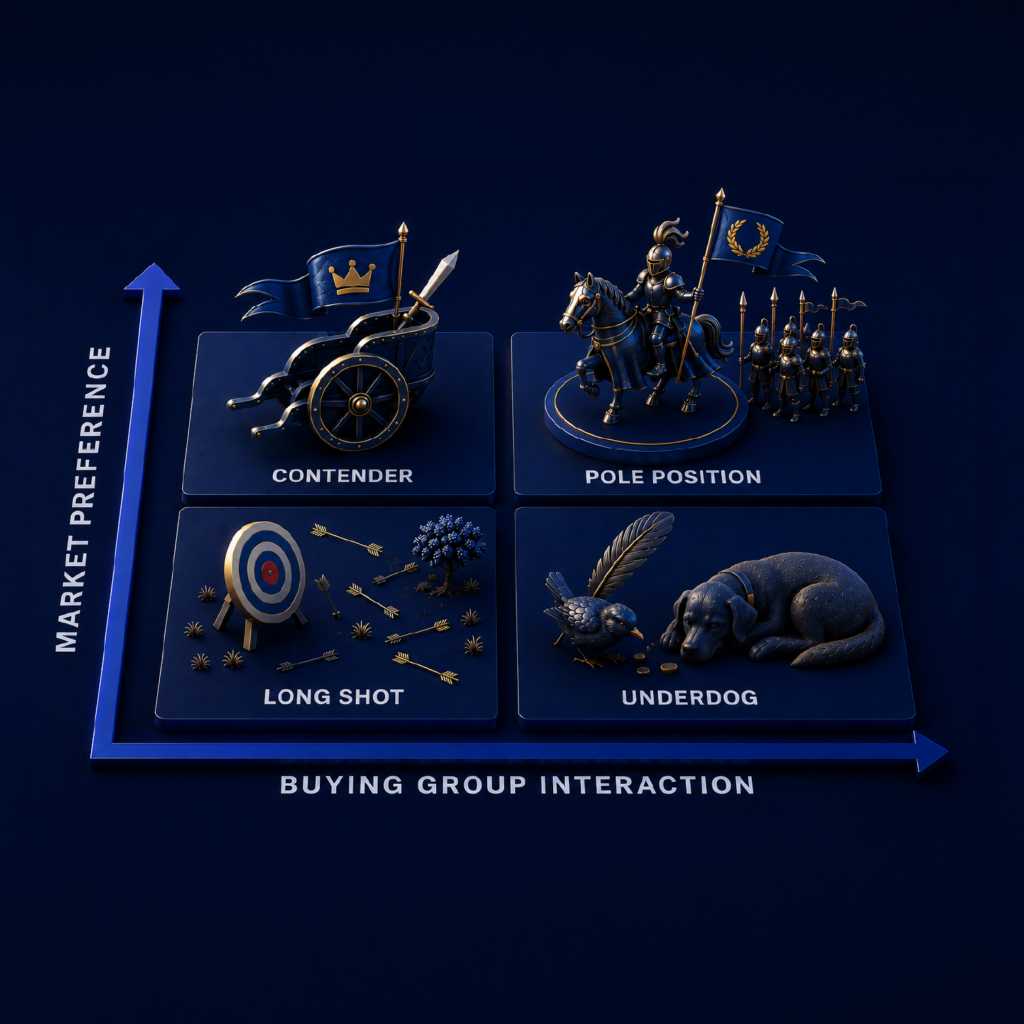
Think about how your buyers see you. Some prefer you heavily and interact with you a lot. Some prefer you but aren’t engaging yet. Some engage with you but don’t prefer you. And some barely know you exist. Your strategy should change depending on where you sit.
Use a simple 2×2 framework like Forrester’s. Plot market preference on one axis. Buying group interaction on the other.
If you’re in high preference and high interaction, you’re in pole position. Your job is to defend that position, validate your value proposition, and expand the size of your opportunity.
If you have high preference but low interaction, you’re a contender. You’ve won the hearts but not the calendars yet. Your priority is converting that preference into active pipeline. You need demand activation.
If you have low preference but high interaction, you’re an underdog. Your job is to maintain that momentum while investing in brand to build trust and credibility. You can’t have enough activity to overcome bad preference.
If you have low preference and low interaction, you’re a long shot. Test the market. Validate ICP fit. Or cut your losses and move on.
Here’s the critical part: shifting preference takes time. Plan for 18 to 24 months. You need brand tracking studies to measure whether it’s working. You need brand and demand coordinated around this reality, not competing against it. Brand seeds demand. That’s not a slogan. That’s the relationship.
The mental models are changing. “Brand is demand” and “brand gen” are replacing siloed thinking. The organizations that figure this out first win.
What Top-Performing CMOs Are Doing Right Now
If you want to see where this is headed, look at what the best CMOs are doing today.
They’re hiring only stars. They’ve stopped adding headcount and started upgrading talent. Fewer roles, higher caliber. Often combining what used to be three separate job descriptions into one. They’re redefining roles around AI use cases. New positions are emerging: GTM engineers who build and orchestrate agents across channels, and dedicated AI operations roles for execution. They’re not adding to the org chart. They’re leveling it up.
They’re making pipeline the top metric. And brand investment is rising alongside it. LinkedIn found that top performers are splitting brand and performance budgets roughly 50/50. Most organizations are still at 70/80 toward demand. The shift is underway. It’s not taking long. The organizations moving first are winning.
They’re getting serious about attribution discipline. High performers are 47 percentage points more likely to have strong attribution coverage. They’re shifting from click metrics to verified buyer intent. When you know which programs actually created qualified opportunities, everything changes. Budget waste drops from 30% to under 23% (DemandScience).
They’re ruthlessly prioritizing what stays and what goes. The badge-of-honor DIY culture is fading. Smaller teams and budgets are forcing openness to partners. Keep your foundational tools. Test alternatives in parallel. Adjust levers based on results. Build adaptive, closed-loop programs that are signal-based, AI-orchestrated, and self-optimizing.
Make the Cut: The Real Question About Your Tools
Here’s the decision framework that matters: Is this tool building preference or activating demand today?
Don’t let sunk cost into the conversation. That’s a trap.
Audit every qualified opportunity in your CRM back to the programs or channels that created it or influenced it. If a tool’s pipeline contribution is small relative to its cost, it’s a candidate for the bin.
Most clients paying the platform tax aren’t using their platforms to full capability anyway. Platforms and partners should support your strategy, not define it. Preference marketing is the strategy. Everything else is execution.
If you’re mid-market, test in smaller increments first. Do a $30K experiment before committing hundreds of thousands of dollars. Diversify your portfolio across channels and partners. Reduce single-point-of-failure risk. It’s okay to test and kill something fast.
The Operating Model Shift Ahead
Here’s what’s changing in the next 18 months: organizations are getting comfortable with speed over perfection. They’re aligning all spend to desired outcomes instead of activity. They’re moving budget from internal overhead to external partnerships that guarantee results. They’re breaking the stack and rebuilding around preference.
The days of feeling insecure about this are over. The insecurity was the overhead. The cost was the internal fiefdoms fighting each other instead of winning together.
McLaren didn’t win the 2024 Constructors’ Championship because they found one magical component. They won because they stopped optimizing in isolation. They coordinated engineering, strategy, data, and driver feedback around one outcome. The same drivers. The same technology. But a faster learning loop.
Your marketing needs the same reset.
The race isn’t won by having better tools. It’s won by having a system that learns faster, coordinates tighter, and aligns all the parts around preference.
That’s what we do at DemandScience.
Start there.
Related Blogs

What is Content Syndication? The Key to Generating Leads and Increasing Conversions
Content syndication is the act of republishing your content to other websites, introducing it to new audiences and…
Read More
Mastering Campaign Measurement: A Guide for B2B Marketers
Measurement is crucial for any marketing or advertising campaign to assess whether your investment paid off. Here are…
Read More
The Hidden Perils of B2B Data Deprecation: A Marketer’s Guide
In B2B marketing, accurate data is essential for success. However, data quality can decline over time due to…
Read More
10 B2B Growth-Hacking Tactics for Lead Generation
Growth hacking is one of the most wide-spread “secrets” of small business start-ups. Its meaning can sometimes get…
Read More
An Inquiry vs. a Lead: What’s the Difference?
Many marketers and sales people assume that inquiries and leads are one and the same, but in fact,…
Read More
10 Examples of Awesome Landing Pages that Convert
To lead more users to your products, you need to create a showstopping landing page. To do this,…
Read More
Lead Quantity vs Lead Quality: Achieving a Balance
Traditional sales and marketing strategies have long focused on lead quantity by casting a wide net to capture…
Read More
What Data Solutions Mean for Marketing Technology?
In recent years, marketing has come to rely on the input of big data in order to create…
Read More
PureBits: Lessons on Life & Sales
Selling is tough. There are many buying signals that a salesperson should watch out for to help them…
Read More
How To Create A Super Engaged Audience For Your Brand
The use of hashtags has become so prominent in content, particularly on social media, that it has penetrated…
Read More
Why Quality Leads are Expensive
Getting more leads at a lower cost is always at the top of lead generation objectives, especially for…
Read More