


Why the AI race is forcing CMOs to confront the operating model underneath their technology
CMOs are being told they need to move faster on AI. I think there’s a more urgent question: What exactly are we asking AI to accelerate?
For many marketing organizations, the uncomfortable answer is an operating model built over the past decade around dozens of technologies, fragmented data, overlapping workflows and significant human effort just to keep the machinery running.
Every addition made sense at the time. Better intent. Better enrichment. Better scoring. Better automation. Better attribution. Better personalization. Yet collectively, those investments often produced something very different from the seamless marketing engine we were promised.
Now we’re adding AI to it.
And there is a real possibility that instead of using AI to eliminate the complexity of the last era, we’re using it to automate that complexity.
That’s why a recent comment from Donovan Neale-May, Executive Director of the CMO Council, caught my attention. He was responding to a post I wrote about DemandScience’s new partnership with ZoomInfo and pointed to the Council’s latest research. His conclusion gets directly at the problem: “The competitive advantage isn’t AI adoption. It’s the operating model behind it.”
The research behind that statement should get the attention of every CMO. In its 2026 Marketing Transformation Performance Audit and Scorecard of more than 200 senior marketing leaders, the CMO Council found that 71% rate their ability to effectively use first-party customer data as ineffective or underdeveloped. Eighty percent aren’t yet highly effective at sourcing and integrating third-party data. Thirty-four percent are struggling with fragmented “Frankenstack” environments and integration challenges, while 75% don’t consider their organizations highly agile and adaptive.
In other words, we’re racing to deploy the most powerful technology marketing has seen in decades on top of an operating model that many CMOs already know isn’t working as well as it should.
AI Rewards the Operating Model Underneath It
Neale-May put the distinction particularly well in his comment: “If marketing operates with connected data, aligned teams and disciplined workflows, AI accelerates growth. If marketing runs on disconnected systems, siloed functions and inconsistent processes, AI simply magnifies the dysfunction.”
There’s evidence that this isn’t just an organizational theory. In separate research cited by the CMO Council, organizations successfully integrating AI and human expertise were nearly twice as likely to report major improvements in campaign ROI, six times more likely to achieve significant gains in personalization, and nearly four times more likely to report major improvements in customer loyalty. The high performers weren’t simply adopting AI. They were defining AI-human roles, redesigning workflows, establishing governance and connecting data.
That’s a pretty extraordinary performance gap.
There’s another disconnect worth paying attention to. Nearly 80% of business leaders expect GenAI to create competitive advantage, yet 60% lack confidence in their organization’s data-AI readiness. We have enormous expectations for what AI will eventually do, but considerably less confidence in the data we’re giving it to work with.
That matters because AI can only reason across the context it can access. If customer information lives in one place, intent signals in another, campaign engagement somewhere else, and sales activity in yet another system, AI doesn’t magically create a coherent view of the buyer.
It may simply allow us to act on fragmented information faster.
We May Be Rebuilding the Platform Tax With AI
This is why I increasingly believe the AI conversation is exposing a problem marketing has been accumulating for years. We have invested enormous amounts of money solving individual technology problems without necessarily solving the larger system problem.
At DemandScience, we’ve been talking about what we call the Platform Tax: the real cost of the traditional martech model. That cost is much bigger than software licenses. It includes integration, implementation, administration, specialized headcount, training, fragmented data, underutilized capabilities and the operational friction required to make multiple systems work together.
AI should dramatically reduce that tax. But that won’t happen simply because the new tools have AI in their names.
I wrote recently that most marketing teams haven’t eliminated martech bloat yet. We’ve just renamed it AI. That risk is becoming more apparent as new tools emerge for outreach, scoring, reporting, enrichment, content creation, workflow automation and virtually every other marketing function.
Each may be inexpensive and compelling in isolation. But five AI vendors can still mean five contracts, five integration points, five sets of data, five potential failure modes and another layer of governance. The technology has changed, but the operating model hasn’t.
Scott Brinker has been writing thoughtfully about a more composable, AI-driven martech architecture in which applications become more interchangeable while data, context and orchestration become increasingly important. I think he’s right about where the architecture is heading. I’ve written about the same shift as value moves away from owning every application and toward the intelligence and orchestration that connects them.
But there’s an important caveat: composability does not automatically equal simplicity. Without a different operating model, it could create even more fragmentation.
The Post-Platform Era Doesn’t Mean Platforms Disappear
When we talk at DemandScience about the Post-Platform Era, we’re not predicting that platforms disappear. CRM, marketing automation and other foundational systems will continue to play important roles. What’s changing is the assumption that the platform itself should be the center of gravity for how marketing technology is built and operated.
For years, much of the martech conversation revolved around which platform should own more of the customer journey. Vendors expanded their suites, customers tried to consolidate applications, and the industry pursued the promise of an integrated platform capable of doing almost everything.
AI changes that equation. As applications and workflows become easier to create, automate and replace, competitive advantage increasingly moves toward the ability to assemble the right data and context, understand what is actually happening with a buyer, determine what should happen next and activate that decision across whatever systems and channels are required.
That’s why I’ve become so interested in Brinker’s idea of “Golden Context,” the intersection of what you know about your company, your systems and your customer. AI agents can be incredibly powerful, but an agent operating on incomplete or misleading context simply makes a bad decision more efficiently.
The strategic question for marketers therefore becomes less about which platform contains the most functionality and more about how effectively the organization can coordinate intelligence and action across an increasingly distributed environment.
From Owning the Stack to Orchestrating Outcomes
This shift also changes how I think about DemandScience’s partnership with ZoomInfo.
The significance isn’t simply that two companies can combine more data. It represents a different approach to creating customer value. Rather than assuming one provider has to recreate and own every capability inside a closed platform, companies can combine complementary intelligence and capabilities around the outcome the customer is trying to produce.
In a more composable world, no company needs to own every component. But someone still has to make those components work together.
That distinction matters because marketing organizations don’t ultimately need another architecture project. They need better pipeline performance. Most mid-market and even many enterprise teams don’t have unlimited data engineering resources, AI expertise or the appetite to integrate and govern a constantly changing collection of tools themselves.
That’s why I believe the Post-Platform Era requires more than composable technology. It needs a managed path through the complexity, one that delivers the benefits of better data, AI and orchestration without transferring the burden of assembling and operating all of it to the customer. It isn’t enough to give marketers more interchangeable components. We need to make more of the complexity underneath them disappear.
The Operating Model Goes Beyond Technology
There’s one more CMO Council finding that I think deserves attention because it shows this problem is bigger than martech. Nearly half of respondents said customer centricity exists primarily as a corporate mandate rather than an operational discipline, and only about one-third believe executive leadership is fully aligned around customer priorities.
You can’t create customer centricity with a platform any more than you can create it with a mission statement. It requires marketing, sales, product, finance and customer success to operate from shared data, shared context and shared outcomes.
Perhaps that helps explain another finding: 37% of marketers say marketing is still viewed internally as a tactical support function rather than a strategic growth driver.
Which brings us to the metric that ultimately matters.
The Real Test Isn’t the Stack. It’s Pipeline.
None of this is really a technology debate. It’s a business performance debate.
Marketing technology investment has grown. AI investment is rising rapidly. Yet many organizations are still struggling to produce proportional improvements in pipeline.
CFOs have noticed.
And that may be the most important reason for CMOs to rethink the operating model now. The question in the boardroom isn’t going to be how many AI tools marketing has deployed. It’s going to be why all of this additional technology, data and investment isn’t producing more pipeline.
I don’t think the answer is another platform. And I certainly don’t think the answer is simply more AI. The bigger opportunity is to rethink the operating model underneath both: connected data, richer buyer context, fewer disconnected workflows, tighter orchestration and a much more disciplined connection between marketing investment and measurable business outcomes.
Donovan Neale-May and the CMO Council are right that AI can accelerate growth or magnify dysfunction. The organizations that win this next era won’t necessarily be the ones that adopt AI fastest. They’ll be the ones that use it to eliminate, rather than automate, the complexity we spent the last decade creating.
That, more than any individual technology, is what I believe the Post-Platform Era is really about.
Where Do We Go From Here?
On August 11, DemandScience is bringing this conversation to Forrester Principal Analyst Kelvin Gee for a live discussion with our Chief GTM Evangelist Chris Moody: The Great Pipeline Reset: How the Post-Platform Era Is Reshaping B2B Demand Generation.

We’ll dig into the questions I think every CMO should be asking right now: Why is increased marketing spend failing to produce proportional pipeline growth? Where is AI actually improving pipeline economics, and where is it simply adding another layer of cost? What are high-performing CMOs changing about their operating models? And how should CMOs explain the spend-versus-pipeline gap to CFOs and the rest of the C-suite?
Those are precisely the issues Kelvin and Chris will tackle, drawing on Forrester’s research and what we’re seeing across B2B marketing today. The webinar is August 11 at 12 PM ET.
If those are conversations happening inside your organization, I hope you’ll join us.
Related Blogs

What is Content Syndication? The Key to Generating Leads and Increasing Conversions
Content syndication is the act of republishing your content to other websites, introducing it to new audiences and…
Read More
Mastering Campaign Measurement: A Guide for B2B Marketers
Measurement is crucial for any marketing or advertising campaign to assess whether your investment paid off. Here are…
Read More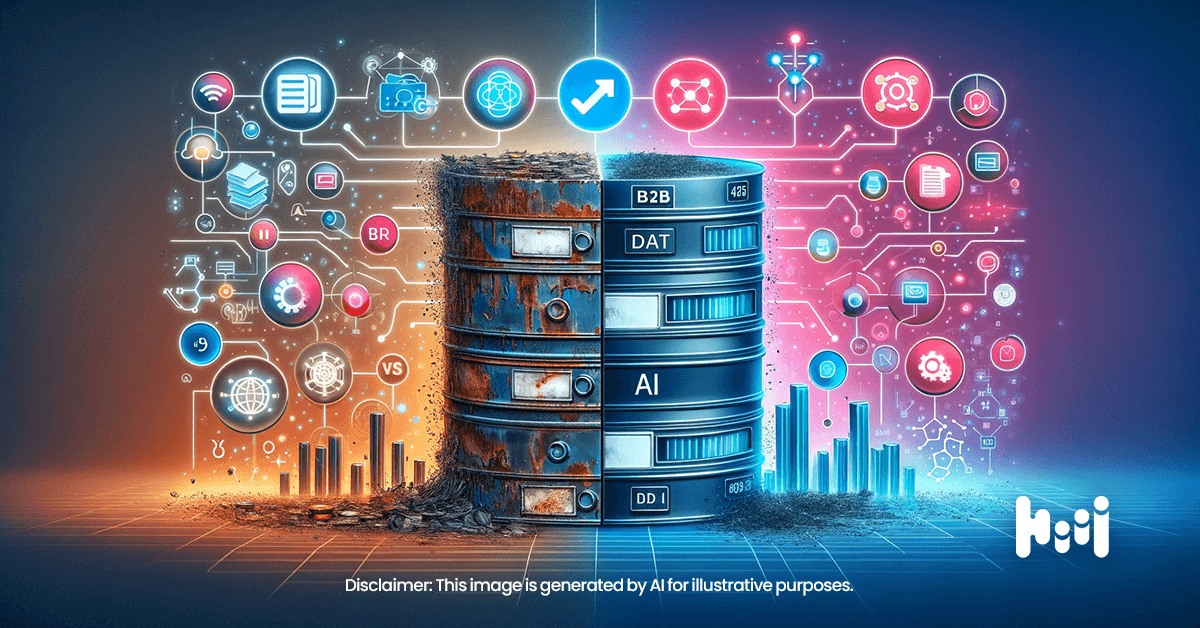
The Hidden Perils of B2B Data Deprecation: A Marketer’s Guide
In B2B marketing, accurate data is essential for success. However, data quality can decline over time due to…
Read More
10 B2B Growth-Hacking Tactics for Lead Generation
Growth hacking is one of the most wide-spread “secrets” of small business start-ups. Its meaning can sometimes get…
Read More
An Inquiry vs. a Lead: What’s the Difference?
Many marketers and sales people assume that inquiries and leads are one and the same, but in fact,…
Read More
10 Examples of Awesome Landing Pages that Convert
To lead more users to your products, you need to create a showstopping landing page. To do this,…
Read More
Lead Quantity vs Lead Quality: Achieving a Balance
Traditional sales and marketing strategies have long focused on lead quantity by casting a wide net to capture…
Read More
What Data Solutions Mean for Marketing Technology?
In recent years, marketing has come to rely on the input of big data in order to create…
Read More
PureBits: Lessons on Life & Sales
Selling is tough. There are many buying signals that a salesperson should watch out for to help them…
Read More
How To Create A Super Engaged Audience For Your Brand
The use of hashtags has become so prominent in content, particularly on social media, that it has penetrated…
Read More
Why Quality Leads are Expensive
Getting more leads at a lower cost is always at the top of lead generation objectives, especially for…
Read More